Baby Showers Quilt

Hi there! It is LeAnne Ballard from Everyday Celebrations with a fun baby quilt for you today. Like many, I absolutely adore the new line April Showers and loved making these two baby quilts. The design is the same for both, appliqued raindrops, but the placement is different for each quilt.

I hope you have fun making this quilt! Check out my other recipes here.

Per Quilt

10 fat quarters*
1 1/2 yards background/neutral fabric
1 1/2 yards backing fabric
1/2 yard binding
2 1/4 yards fuisble webbing (I prefer Heat n’ Bond Lite or you can use your preferred applique method.)
template plastic (Print out raindrop template and trace onto template plastic. Transfer markings from the raindrop onto the template plastic. Cut out template.)
batting

*Note: You could also use jelly roll strips for the scrappy raindrops and fat quarters/fat eighths for the solid raindrops.

Decide whether you want to make the normal or staggered layout:


 *All seams are 1/4″ unless noted.

Cutting

From the 1 1/2 background/neutral cut:
{4} 12.5″ x WOF strips
subcut into {4} 10.5″ x 12.5″ rectangles for a total of {16} rectangles
*Note: If you are making the staggered raindrop quilt, trim {4} of the rectangles to 10.5″ x 12.25″. Place these in a separate pile and label. This is the only cutting difference between the quilts.

From each fat quarter cut:  the remaining fat quarter will be used for the solid raindrops
{2} 2.5″ x 21″ (or width of the fat quarter) strips
from each strip subcut {1} 9.5″ x 2.5″ and {1} 11.5″ x 2.5″ (I just left the remaining strip. The strip needs to be at least 11.5″.)

Binding
From the 1/2 yard for the binding cut:
{5} 2.5″ x WOF strips

Prepare Applique
Trace {16} raindrops onto the fusible webbing using the raindrop template. Transfer markings onto the fusible webbing. Roughly cut around each raindrop leaving about 1/4″ around each raindrop.  Next, cut out the centers of the raindrops leaving about 1/2″. This will help keep the quilt cuddly and soft instead of stiff from the fusible webbing.

Block Assembly

Vertical Raindrops

1. For each vertical raindrop select {4} 2.5″ x 11.5″ strips.  Arrange as desired and sew.  Press seams OPEN. Make a total of {4} vertical units. (You will have extra of these strips.)

2.   Flip the unit over and line up the mark at the bottom with the center seam as shown below. Line up the tip of the raindrop with the same center seam. Quickly fuse in place. (I found it easier to “baste” the fusible web in place by quickly lifting the iron up and down over the webbing. Then I flipped the unit over to the front and fused as directed by my instructions. Otherwise, it was easy to  mess up the directions of the seams.) 
 
 
3. Cut out the raindrop. Leave paper in place until you are ready to fuse in place. Repeat for {4} vertical raindrops.
Horizontal Raindrops
1.  For each horizontal raindrop select {5} 2.5″ x 9.5″ strips.  Arrange as desired and sew.  Press seams open. Make a total of {4} horizontal units.

2. To line up this raindrop, fold the unit in half and lightly press to create a crease. Fuse the webbing in place just like you did for the vertical raindrops, just use the crease as you guide. Repeat for {4} horizontal raindrops.

 Solid Raindrops

1.  Select {8} of the fat quarters for your solid raindrops. Fuse the raindrop fusible web onto the remaining part of the fat quarter. (Follow the directions for your brand of fusible webbing.)

2.  Allow to cool then cut on tracing line. Repeat for {8} solid raindrops.

Patchwork Raindrop
If you opt to make this block, make in place of one of the solid raindrops.

1. From one of the remaining fat quarters cut {1} 4.75″ x 11″ piece and {1} 3.5″ x 11″ piece. From the leftover 2.5″ strips cut {6} 2.5″ squares.

2. Sew together all the 2.5″ squares. Press seams all one direction. Trim unit to measure 11″ long.  I just trimmed a little off the top and bottom.

3. Sew the pieces cut from the fat quarter to either side of the patchwork unit. Mine didn’t line up exactly which is fine. It doesn’t have to be perfect.

4.  Flip unit over with the patchwork unit to your left.  Line up the mark on the raindrop with the seam line running the length of the patchwork unit. Fuse in place and cut raindrop out.


Fuse Raindrops to Background

1. Fold the background rectangles in half lengthwise to create a crease.

2. Remove paper backing and center raindrop onto the rectangle. Raindrop should be about 1.5″ inches from the sides and 1.25″ from the top and bottom.  Fuse in place following webbing directions. Repeat for all raindrops.
*For the staggered layout: Adhere {2} of the SOLID and {2} of the VERTICAL raindrops to the slightly smaller (12.25″ x 10.5″) rectangles. These will go in the positions shown below. (Don’t sew the quilt top together yet, this picture just references where the smaller rectangles will go.)

3. Machine stitch around each raindrop to secure in place. This can be done in a variety of ways. You could use a zig-zag, satin, blanket (if your machine has that option), or a simple straight stitch.  For my quilts I opted to use a blanket stitch and straight stitch. With the straight stitch, I sewed about 1/4″ away from the edge of the raindrop. Note if you choose to use a straight stitch, the raw edges will fray and wear over time. This step is easiest to do BEFORE you sew the quilt top together. 

Quilt Assembly

For the regular layout:
1. Arrange the quilt units in {4} rows of {4} as shown below.

2. Sew units together in rows and press seams one direction, alternating from row to row.  Then sew rows together. Press seams one direction. Press entire quilt top.

For the staggered layout:
3. Cut 2 of the SOLID raindrops in half, NOT the slightly smaller ones. Cut the unit in half to make {2} 6.25″ x 10.5″ units. These will go in the positions below:

4. Sew units together in rows and press seams one direction, alternating from row to row.  Then sew rows together. Press seams one direction. Press entire quilt top.

5. Then baste, quilt, and bind!


 one 40″ x 48″ baby quilt

LeAnne Ballard

Tips and Tricks: Out of the Box Storage

Reader T. Baker shared an “out of the box” storage solution for in-progress projects – pizza boxes! They’re large, lightweight, easy to find new (and cheese-free) online, and much cheaper than conventional plastic storage bins. You can find them in plain white or dress up the brown version with some decoupage. The only cuter way to store WIPs just might be a pink bakery box.

For more storage ideas, check out {this post} from Oda May.

Have A Heart Baby Quilt


Hi, my name is Alison Tudor of Sew and Tell Quilts. This is a fun and quick project that could make a wonderful quilt for a baby girl or a large Valentine’s Day wall hanging.


Moda fabric Printemps
Designer 3 Sisters
Materials Needed: 
1 Jelly roll 44030JR 
1-1/2 yards  Printemps Linen 44035-11 for background and border blocks. 
3/8 yd Printemps Primrose 44030-13 for border. 
1/2 yd Printemps Tonal Scarlet 44036-15 for inner border.   
1/8 yd Printemps Scarlet 44037-15
1/4 yd Printemps Tonal Primrose 44036-13
3 yards backing fabric
3/8 yd binding fabric (5 strips 2.5″)


Cutting Directions

Cut 251 2-1/2″ squares of Printemps Linen 44035-11 for the background and border blocks.
Cut 24 2-1/2″ squares of Printemps Tonal Primrose for the inner corners.
Cut 59 2-1/2″ squares of a good mix of light and dark prints from the jelly roll for the heart.
Cut 4 2-1/2″ squares  Printemps Scarlet for the “L” 
Cut 4 2-21/2″ squares Printemps Pond 44031 14 for the “O”
Cut 5 2-1/2″ squares Printemps Scarlet 44037 15 for the “V”
Cut 4 2-1/2″ squares Printemps Buttercup 44034 12 for the “E”
Cut 4 1-1/2″ x WOF strips Printemps Tonal Scarlet 44036-15 for inner border.  
Cut 42 2-1/2″ squares Printemps Primrose 44030-13 for outer border blocks.

From your choice of binding fabric, cut 5 strips measuring 2½” x WOF  

Quilt Assembly

Working in sections, following the sectional layout diagram, sew the 2-1/2″ squares together to construct the rows. Press the seams in opposite directions for each row to help make the seams line up as you build the quilt top. Once all the sections have been completed, stitch the sections together to complete the quilt top center.

Sections Diagram

Making The Borders
 For the inner border, cut two 1-1-2″ strips 38″ long and two 1-1/2″ strips 40-1/2″ long. Sew these to the sides and the top and bottom of the quilt top center.  For the outer border, alternately join pink and cream colored 2-1/2″ border blocks to make a strip.  Two sides should require 20 blocks; 10 of each color measuring 40″. Two sides should require 22 blocks; 11 of each color measuring 44″.  Sew these to the sides and the top and bottom of the quilt to complete the top.

Quilt Layout Diagram

Finished quilt 44″ x 44″

Alison Tudor
{Sew and Tell Quilts}

Quilt As You Go Improv Pillows


Hi All! This is Jera from www.QuiltingintheRain.com bringing you a creative weekend project. This pillow uses a modern Quilt as you Go technique which will be featured in my upcoming book, Quilt-As-You-Go Made Modern, to be released this Fall. I’m so excited to share this technique with you all!
 
The Quilt as you Go technique is very creative as it doesn’t follow a precise pattern. Rather, it takes on more of a improvisational style of piecing and quilting. For updates on my latest quilting endeavors, check out my Quilting in the Rain Facebook page and blog. You can also find me on Instagram. Thanks so much for stopping by and enjoy the tutorial!


Please Note – For this pillow I used leftover Layer Cake squares from the April Showers Collection by Bonnie and Camille. Leftover fat quarter scraps will work too. For the solid borders, I used Moda Solids Prairie Cloth in Buff (this material is home decor weight but has a linen/canvas feel to it). For the back of the pillow, I used Moda’s Twill (home decor weight), Nautical Ticking Stripes in Red.

For Pillow No.1 (14″ x 14″ pillow cover):

  • 1 layer cake square (or a 10″ square cut from a fat quarter) 
  • 1/4 yard border fabric
  • 3/8 yard Backing
  • 15.5″ x 15.5″ batting square (needle-punched batting)
  • pillow insert

 For Pillow No.2 (16″ x 12″ pillow cover):

  • 6 layer cake squares for variety (or six different fat quarter prints)
  • 1/4 yard border fabric
  • 3/8 yard backing  
  • 17.5″ x 13.5″ batting square (needle-punched batting)
  • pillow insert 


    For Pillow No. 1 (14″ x 14″ pillow cover):

    1.  Take a 10″ square and place it in the center of the batting. Place a few pins to help keep it down. Then, quilt it directly to the batting. As shown below, make sure your stitch starts and ends on the batting.

    I did free-motion quilting with some simple loopy-loops. If you’ve never free-motion quilted before, now is a good time to try it out as it’s easier to do it on a smaller, more manageable block.

     2. From your border fabric, cut two 3.5″ strips along the length. Take a strip and trim it with fabric scissors so it’s the same length as the side of the square. With right sides facing together, sew a 1/4″ seam allowance.

    3. Press open, and then quilt lines that run parallel to the seam. There will be some extra fabric hanging over the batting. As shown below, make sure your stitch starts and ends on the batting.

    4. Take the strip and trim it with fabric scissors so that it measures the length of the square and strip that you just pieced together, as shown below. With right sides facing together, sew a 1/4″ seam allowance.

    5. Press open, and then quilt lines that run parallel to the seam. There will be some extra fabric hanging over the batting. 

    6. Repeat the previous steps until there is border fabric surrounding all four sides of the square. You are essentially piecing fabric in a log-cabin style method, but quilting it directly onto the batting as you go.
    When you are finished, the entire batting will be covered and will look similar to this.
    The back will look similar to this:
    Flip the block over so the batting side is facing you. Trim the excess fabric sticking out side of the batting. Then, flip it over so the patchwork is facing you and trim approximately 1/4″- 1/2″ from all four sides so that your block measures 14.5″x14.5″.
    7. Next, create an envelope closure for the backing. From your backing fabric, cut two 11″x14.5″ rectangles. Along the length,  turn the edge 1/4″ under, press, then turn under 1″, then press again. Stitch along the fold to keep in place to create a pretty seam. Repeat on the other rectangle as well. 
    With right sides facing together, take one rectangle and align it along the left side of the pillow cover. The finished seam you created from the previous step should be facing toward the right. Pin to keep in place, then sew a 1/4″ seam allowance along the perimeter as illustrated by the dashed line below. Start and end your stitch with a back-stitch.
    Repeat with the other rectangle, but align it on the right side of the pillow. Lastly, trim the corners to get rid of bulk fabric, and then turn right side out.
    Insert the pillow and there you have it! 🙂

     
    For Pillow No.2 (16″ x 12″ pillow cover):
    Please note: For this pillow, the same exact technique that was described above (for pillow No.1) was used, except with smaller pieces of fabric. The technique I explained from the first pillow will give you the basic understanding you need to complete this next pillow. That being said, I will not list step-by-step instructions.  Rather, I have listed the order in which the strips should be pieced. Enjoy!
    1. From your fabric, cut one 3″ square and a couple 2″ strips from each print (you will trim these strips as needed).
    2. Start by placing the 3″ square in the center of the batting, and then quilt it. Next, add strips making sure to trim them with fabric scissors to the correct size. Add the strips in the following order, using the quilt as you go method previously described. For this pillow, I quilted straight lines that ran parallel to all of the seams. 
    Tip! Fabric can shift while stitching on the batting. Correct for this by keeping the strips aligned and ‘square’ them as necessary. The seams of each successive piece should be at a 90° angle to the previous quilted piece. 
    Also, please note that your pieces will shift around slightly and the batting will stretch a little – this is completely normal. So don’t expect yours to look as straight as the illustration above. =)
    3. From your border fabric, cut one 5-6″ wide strip along the length. With right sides facing together, place the strip along the length of the patchwork as shown below. Overlap the strip with the patchwork as needed to straighten it out, and as mentioned in the “Tip!” above. Sew.
    4. Press the strip down, and then quilt lines that run parallel to the seam. Repeat for the top so that the entire batting is covered.
    5. Flip the block over so the batting side is facing you. Trim the excess fabric sticking out side of the batting. Then, flip it over so the patchwork is facing you and trim approximately 1/4″- 1/2″ from all four sides so that your block measures 16.5″x12.5″.
    6. Next, create an envelope closure for the backing. From your backing fabric, cut two 11″x12.5″ rectangles. Repeat step 7 from Pillow No.1 to create the envelope closure and to finish your pillow. 
    And that’s it! Quilt as you Go is a fun and different way to quilt. I hope you enjoyed learning this new improvisational technique! Now that you know the concept, you can get really creative with all the other fun Quilt as you Go pillow designs you can think up! 
    (Above: Paige modeling a Quilt as you Go strip quilt using the Scrumptious collection by Bonnie and Camille).
    Come visit me at www.QuiltingintheRain.com for more Quilt as you Go projects. You can also find me on Facebook and Instagram.
    Let your creativity rain!
    xoxo
    -jera brandvig

    Tidy Linens Bag


    Hi! Lisa Calle of Vintage Modern Quilts here today with a very easy project that will help you get a jump in your spring cleaning. A couple of years ago I bought a set of sheets that came with a handy little storage bag and I thought it was a great idea. The only problem? There was no way I’d ever be able to fold those sheets up as small and tidy as they were straight out of the package and they never fit into the bag again. So what’s a girl with a sewing machine and tons of fabric to do? Make my own cuter linens storage bag!

    The hardest part of this project is folding that fitted sheet. I made mine for queen size sheets but it will fit king or full, as well. You may want to decrease measurements all over by 1″ to 2″ for twin sheets.

     
    2 fat quarters (I used a pair of gray prints from V and Co.’s Color Me Happy line)
    8″- 11″ of Velcro
    Marking pen


    Hand sewing needle and embroidery thread


    Cut each of your fat quarters into a 14″ x 15″ rectangle. If you are using a directional print, the 15″ measurement is your length. From the remaining pieces of each fat quarter, cut a 6″ x 8″ rectangle. Set these smaller rectangles aside.

    Sew a 1/4″ hem along the top of each large rectangle (or use a serger, if you have one).  Trim a 2½” square from the bottom left and right corners of each rectangle.

    Place rectangles right sides together and sew a  ¼” seam along the sides and the bottom, leaving the top and the corners open. Be sure to back stitch at each edge. Press seams.


    Box the corners of your bag to create depth. To do this, pinch the fabric together so that the seams line up as pictured.

    Sew ¼” seam along each boxed corner, back stitching at the beginning and end of your seam.

    To create the fold-over flap of your bag, join the small (6″ x 8″) rectangles together along the long side. Press the seam to one side. Hem all sides of the resulting rectangle.

    Determine which side of the bag will be the front. Find the center of the back of the bag and match up with the center of the flap, right sides together. Sew a ¼” seam to join these sections.

    Pin one strip of the Velcro along the inside of the bag flap, close to the edge. Sew ⅛” around the Velcro to attach it to the bag. Put your folded sheets in the bag and close the flap firmly, marking where the edge meets (use a removable marking pen). Remove the sheets from the bag and pin the other piece of Velcro just a hair above your mark, again sewing a ⅛” around the Velcro to attach it to the bag.

    That’s it! You are done. But if you want to take this project up another notch, use embroidery floss to add some important info to the bag. Are these sheets for the guest room? Your child’s room? Or maybe just add the size.


    1 tidy linens bag

    Lisa Calle
    {vintagemodernquilts.com}

    Tiles Quilt


    Hello,  my name is Cindy Sharp.  I am the person behind Tops to Treasures.  I am thrilled to be back with Moda’s Bake Shop today…presenting my original pattern, “Tiles.”

    The name isn’t very flashy, but I could think of no better word to describe the effect of this pattern.  It takes me back to a time when things were made for both beauty and function, when floors were more than something to walk on, and back splashes did more than protect the kitchen wall.  
    Using the Printemps line of fabric by 3 Sisters elevates my tiles to a whole other level.  These carefully pieced blocks no longer belong on a floor or wall, but in a garden filled with life and light and fresh air.  It is wholly appropriate that this line was given the name Printemps.  French for springtime, the name delivers all that it promises.
    The drawings in my pattern feature a different line of fabric, also by 3 Sisters.  Vin du Jour provided the heady bouquet of color that inspired my pattern.  
    In either fabric line the quilt is fantastic.  I hope you enjoy it as much as I do.
    Tiles is made from 30 blocks that finish at 12″ square.  There are 15 blocks that turn one way and 15 blocks that turn the other.  You can see it in the quilt if you look for mirror images.  To get a better understanding look at the drawings below.  Pay close attention to the rotation of the edge pieces.  In the picture on the left  the golden arm is reaching toward the right….the edge patch arms all reach in the same rightward direction.  (Is rightward a word?  Did I just make that up?!)  In the other picture they all reach toward the left.
    Right Reaching Block
    Left Reaching Block
    Each of the 30 blocks is made from 9 patches.  I like the center patch the best!  It is just a 4 1/2″ square!
    Corner Patch
    The corner patches are straight forward as well.  They are pieced, but the directions are the same for every corner patch in the quilt.
    Left Reaching Edge Patch
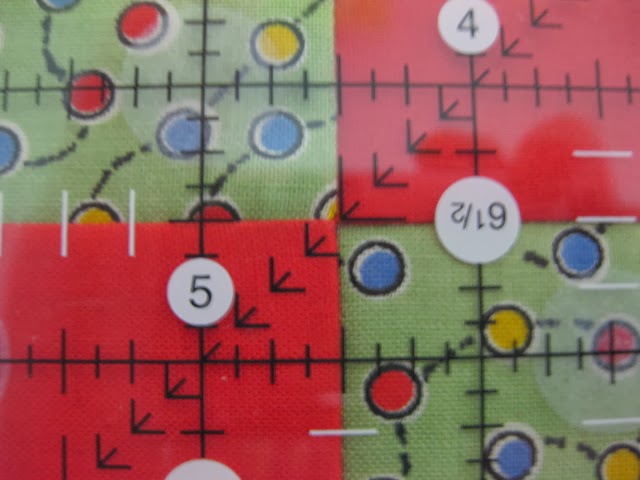
    The edge blocks are the tricky part.  Due to the restrictions of standard markings on my ruler (not just mine, yours are marked the same way) I chose to foundation piece this portion of the block.   Please don’t be turned off by this decision.  I’ve written a tutorial to help you with this type of construction.  The process is as straight forward as that used in the corner patches…it is just different.  Time to grow my quilty friends.  You can do this!  If you have any trouble understanding the process please feel free to contact me.  I’d love to walk you through it.
    I designed Tiles to take advantage of dark and light colors in a fabric line.   There are several in the Moda line up that would work.  My drawings are all done using Vin du Jour by 3 Sisters.  It is a striking quilt when done in just a few colors.

    My sample quilt is made using Printemps also by 3 Sisters.  This line is softer.  Where Vin du Jour is dramatic and bold, Printemps is romantic and subtle.  Using a softer pallet will create more of a blended quilt.

    What ever you decide keep in mind that you need approximately the same amount of yardage for either option.

    For a scrappy quilt, like mine, use the fat quarter equivalents listed in parenthesis.   There should be enough fabric in a fat quarter bundle to obtain the variety that you need, however, some fabric lines lean more heavily towards lights or darks.  If this is the case with the one you have chosen remember to supplement your bundle purchase with enough yardage to complete the light/dark requirements.

    Yardage Required
    (#FQs)
         SKU
    What I used
    Dark
    1 1/4 yds (5)
    44031-15
    44037-15
    44036-15
    44030-15
    44030-25
    5 reds from Printemps by 3 Sisters
    Light
    1 1/4 yds (5)
    44033-12
    44032-22
    44031-12
    44030-22
    44030-12
    5 yellows from Printemps by 3Sisters
    Lattice A
    1 yd (4)
     44032-23
        44031-13
        44036-13
        44030-13
        44035-23
    5 pinks from Printemps by 3 Sisters
    Lattice B
    1 yd (4)
        44037-14
        44031-14
        44032-24
        44030-24
        44030-14
    5 aquas from Printemps by 3 Sisters
    Background
    2 3/4 yds
     44036-41 tiny pink floral on cream
    Inner Border
    ½ yd
     44303-24 tone on tone aqua 
    Outer Border
    1 1/4 yds
     44033-12 medium floral on yellow
    Binding
    3/4 yd
     44037-15 white diamonds on red
    Backing
    5 yds
     44030-12 large floral on yellow
    • 12 Sandwich sized zip lock baggies:  To  make your P.I.G. (project in a sack) easier to corral I highly recommend placing your pieces in zip lock baggies as you cut them.  You will need 12 baggies to do this.  Place all 30, 4 1/2″ x 4 1/2″ dark squares in one bag, all 120, 2 1/2″ x 2 1/2″ dark squares in another bag, etc.  If you use the kind that has a freezer label built into it you can write yourself a note as to the size and purpose of the piece.  (I didn’t bag up my borders or binding.)
    • 60 paper copies of each page on the following file:  Edge Patch Pattern You should have 60 of each of 2 pages for a total of 120 pages.
      • Before you print 60 copies
        • Please make sure that the solid lines forming the right angles measure 4″
        • Mark the pattern pieces of the original copy so that you know which piece goes to which type of block.  (This will be important if your piles get knocked over.)
        • Consider making a few extra copies….just in case.
       
      Cutting Directions:
      • Darks
        • 30, 4 1/2″ x 4 1/2″ squares for center of blocks
          • If from yardage –
            • Cut 4, 4 1/2″ x width of fabric (wof) strips
            • Sub-cut 3 strips into 9, 4 1/2″ x 4 1/2″ squares each for a total of 27 squares
            • Sub-cut 3, 4 1/2″ x 4 1/2″ squares from the remaining strip to complete 30.
          • If from fat quarters
            • Cut 8, 4 1/2″ x 18″ strips
              • 2, 4 1/2″ x 18″strips from each of 3 fat quarters,
              • + 1, 4 1/2″ x 18″ strip from the 2 remaining for a total of 8 strips
            • Sub-cut strips into 4, 4 1/2″ x 4 1/2″ squares each for a total of 32.  (you will have two extra.)
        • 120, 2 1/2″ x 2 1/2″ squares for corner patches of blocks
          • If from yardage –
            • Cut 8, 2 1/2″ x wof strips
            • Sub-cut 7 strips into 16, 2 1/2″ x 2 1/2″ squares from each for a total of 112 squares
            • Sub-cut 8, 2 1/2″ x 2 1/2″ squares from the remaining strip to complete 120
          • If from fat quarters –
            • Cut 18, 2 1/2″ x 18″ strips
              • 4, 2 1/2″ x 18″ strips from each of 3 fat quarters
              • + 3, 2 1/2″ x 18″ strips from the 2 remaining for a total of 18 strips
            • Sub-cut 17 strips into 7, 2 1/2″ x 2 1/2″ squares each for a total of 119 squares
            • Sub-cut 1, 2 1/2″ x 2 1/2″ square from the last strip to complete 120
      • Lights
        • 60, 5″ x 5″ squares for corner patches of blocks
          • If from yardage –
            • Cut 8, 5″ x wof strips
            • Sub-cut 7 strips into 8, 5″ x 5″ squares each for a total of 56 squares
            • Sub-cut 4, 5″ x 5″ squares from the remaining strip to complete 60
          • If from fat quarters –
            • Cut 15, 5″ x 22″ strips
              • 3, 5″ x 22″ strips from each of 5 fat quarters
            • Sub-cut 4, 5″ x 5″ squares from each strip for a total of 60

      • Lattice A
        • 60, 3 1/2″ x 2″ rectangles for edge piece A2
          • Cut 5, 2″ x wof strips
          • Sub-cut strips into 12, 3 1/2″ x 2″ rectangles each for a total of 60 rectangles
        • 60, 6 1/4″ x 2″ rectangles for edge piece B2
          • Cut 3, 6 1/4″ x wof strips
          • Sub-cut 2 strips into 21, 2″ x 6 1/4″ rectangles each for a total of 42 rectangles
          • Cut 18, 2″ x 6 1/4″ rectangles from the remaining strip to complete 60
      • Lattice B
        • 60, 3 1/2″ x 2″ rectangles for edge piece A2
          • Cut 5, 2″ x wof strips
          • Sub-cut strips into 12, 3 1/2″ x 2″ rectangles each for a total of 60 rectangles
        • 60, 6 1/4″ x 2″ rectangles for edge piece B2
          • Cut 3, 6 1/4″ x wof strips
          • Sub-cut 2 strips into 21, 2″ x 6 1/4″ rectangles each for a total of 42 rectangles
          • Cut 18, 2″ x 6 1/4″ rectangles from the remaining strip to complete 60
      • Background
        • 60, 4″ x 4″ squares for corner patches of blocks
          • Cut 6, 4″ x wof strips
          • Sub-cut 10, 4″ x 4″ squares from each strip for a total of 60 squares. 
        • 120, 4 1/2″ x 2 1/2″ rectangles for edge piece A1
          • Cut 8, 4 1/2″ x wof strips
          • Sub-cut 7 strips into 16, 2 1/2″ x 4 1/2″ rectangles each for a total of 112 rectangles
          • Cut 8, 2 1/2″ x 4 1/2″ rectangles from the remaining strip to complete 120
        • 120, 2 1/2″ x 2″ rectangles for edge piece A3
          • Cut 8, 2″ x wof strips
          • Sub-cut 7 strips into 16, 2 1/2″ x 2″ rectangles each for a total of 112 rectangles
          • Cut 8, 2 1/2″ x2″ rectangles from the remaining strip to complete 120
        • 120, 3 1/2″ x 2″ rectangles for edge piece B1 
          • Cut 6, 3 1/2″ x wof strips
          • Sub-cut 5 strips into 21, 2″ x 3 1/2″ rectangles each for a total of 105 rectangles
          • Cut 15, 2″ x 3 1/2″ rectangles from the remaining strip to complete 120
      • Inner Border
        • Cut 8, 1 1/2″ x wof strips
      • Outer Border
        • Cut 8, 5 1/2″ x wof strips
      • Binding
        • Cut 8, 2 1/2″ x wof strips
      • Paper patterns – cut triangles apart just outside the dotted lines.
        Break Time!
            The Whole Valley In a Glass of Wine
        If you just made it through all of that cutting, you really do deserve a break.  Just writing the instructions wore me out.  Put down the rotary cutter for the evening, put your feet up, and enjoy a relaxing beverage….a massage probably wouldn’t hurt either.
        Sewing Directions:
        Corner Patch
        • Corner Patches – Does anyone else think this block looks like an Angry Bird?!  You need to make 120, 4 1/2″ x 4 1/2″ (actual size) patches.
          • Gather baggies containing –
            • 120, 2 1/2″ x 2 1/2″ squares dark fabrics
            • 60, 5″ x 5″ squares light fabrics
            • 60, 4″ x 4″ squares  background fabric
          • When working with triangles, I like to leave things square as long as I can.  Making these patches two at a time accomplished that perfectly.
          • Gather
            • 2, 2 1/2″ x 2 1/2″ squares dark fabric
            • 1, 5″ x 5″ square light fabric
            • 1, 4″ x 4″ square background fabric
          • Sub-cut the 4″ square of background fabric diagonally twice – making 4 small triangles
          • With right sides together, align right angle of 1 small triangle with right angle of small square.
        Corner step 1
          • Sew pieces together.
          • Carefully iron seam allowance towards the triangle.  Be careful not to warp the triangle shape.
          • With right sides together, align right angle of second small triangle with opposite right angle of small square so that the “bunny ears” intersect.
        Corner step 2
          • Sew pieces together.
          • Carefully iron seam allowance towards the triangle.  Be careful not to warp the triangle shape.
          • You should now have a large triangle made of three pieces.
          • Sub-cut 5″ x 5″ square light fabric diagonally, once – making two large triangles.
          • With right sides together, center pieced triangle on top of large triangle, aligning the hypotenuses.  Note – the pieced triangle is a little bit smaller than the large one.  It is supposed to be this way.
        Corner step 3
          • Iron seam allowance towards the large triangle.  Be careful not to warp the triangle shape.
          • Trim patch to 4 1/2″ x 4 1/2″ square.
          • Repeat with remaining pieces to make a second patch.
          • Repeat 59 more times to make required 120 corner patches.
        Left Reaching Edge Patch
        • Edge Patches – This patch looks like a  Y to me.  You need to make 60 Right facing and 60 left facing, 4 1/2″ x 4 1/2″ (actual size) patches.
          • Gather
            • Lattice A fabric
              • 60, 3 1/2″ x 2″ rectangles for edge piece A2
              • 60, 6 1/4″ x 2″ rectangles for edge piece B2
            • Lattice B fabric
              • 60, 3 1/2″ x 2″ rectangles for edge piece A2
              • 60, 6 1/4″ x 2″ rectangles for edge piece B2
            • Background fabric
              • 120, 4 1/2″ x 2 1/2″ rectangles for edge piece A1
              • 120, 2 1/2″ x 2″ rectangles for edge piece A3
              • 120, 3 1/2″ x 2″ rectangles for edge piece B1 
            • Paper foundation patterns
              • 60, right reaching
              • 60, left reaching
          • Use instructions in Paper Piecing tutorial to complete 120 edge patches.  I highly recommend that you keep your left reaching and your right reaching patches in separate piles.
          • NOTE: 
            •  You can easily tell a right reaching from a left reaching by setting the block in front of you with the largest triangle closest to you.  Thus situated, look at the long arm of the Y.  It reaches up and to the ______.
            • Paper Piecing is done “upside down”  do not worry if your left blocks look like right blocks and your right blocks look like left blocks.  As long as the group called left all look like each other and different from the group called right you are doing okay.
        • Blocks
          • Use the pictures for each block
          • Make one block at a time.
          • Lay your patches out in front of you and make sure that…
            • The largest triangle in the edge patch always touches the center patch.
            • The Lattice fabrics appear to continue through the block.  It kind of looks like four sticks arranged end to edge to create a large square on point.  The opposite sides of this square are the same color.
            • If the lattice sticks look broken, or you can’t get them to line up correctly, you probably have a mixture of left and right reaching edge patches.
            • The small dark squares always touch the large dark square in their interior corners.
        Right Reaching Block
          •  15, Right Reaching
            • Gather
              • 15, 4 1/2″ x 4 1/2″ squares dark fabric
              • 60, corner patches
              • 60, right reaching edge patches
            • Use tips outlined above to construct 15 blocks
            • Trim blocks to 12 1/2″ x 12 1/2″


        Left Reaching Block
          • 15, Left Reaching
            • Gather
              • 15, 4 1/2″ x 4 1/2″ squares dark fabric
              • 60, corner patches
              • 60, left reaching edge patches
            • Use tips outlined above to construct 15 blocks
            • Trim blocks to 12 1/2″ x 12 1/2″

        • The Top
          • Center
            • Gather
              • 15 Right Reaching Blocks
              • 15 Left Reaching Blocks
            • On a design wall (Read shower  curtain, large bed, floor if you do not have a formal design wall.  Really, these things work just as well, if not a little more awkwardly.) arrange you blocks.
              • Rows 1, 3, and 5 are all Right, Left, Right, Left, Right
              • Rows 2, 4, and 6 are all Left, Right, Left, Right, Left
              • All blocks are arranged so that Lattice A and Lattice B fabrics are oriented the same way.  In my picture you can see, all of the yellow sticks are on top and bottom of the blocks and the grey sticks are left and right.  Yours should be this way too.
              • If you are having a hard time getting the lattice to line up correctly you probably have the wrong kind of block.  Make sure the block is reaching in a different direction than the one you are placing it next to.  It is easy to do this by laying the blocks on top of each other.  You can’t miss the differences this way.
            • Sew blocks into rows.
            • Iron seam allowances towards the right reaching blocks
            • Sew rows together to complete center. 
            • It should measure 60 1/2″ x 72 1/2″.
          • Inner Border
            • Gather
              • 60 1/2″ x 72 1/2″ center
              • 8, 1 1/2″ x wof strips of inner border fabric
            • Sew 4, sets of 2, wof strips together skinny end to skinny end.
            • Iron seam allowance open.
            • Sew long skinny strip to top and bottom of center 
            • Iron seam allowances towards the inner border
            • Trim excess
            • Sew long skinny strip to each side of center
            • Iron seam allowances towards the inner border
            • Trim excess
            • Your top should now measure 62 1/2″ x 74 1/2″
          • Outer Border
            • Gather
              • 62 1/2″ x 74 1/2″ center
              • Cut 8, 5 1/2″ x wof strips outer border fabric
            • Sew 4, sets of 2, wof strips together skinny end to skinny end.
            • Iron seam allowance open.
            • Sew long skinny strip to top and bottom of center 
            • Iron seam allowances towards the outer border
            • Trim excess
            • Sew long skinny strip to each side of center
            • Iron seam allowances towards the outer border
            • Trim excess
            • Your top should now measure 72 1/2″ x 84 1/2″
        • Layer and quilt as desired.  I used a pattern called Chantilly Lace by Anne Bright with Praline thread by Signature.
        I’d love to see your finished quilt.  Please send me a picture, or add it yourself to my Tops to Treasures group on Flickr.

        A 72″ x 84″ quilt to be proud of.  This one will knock your socks off when it is finished.

        Cindy Sharp
        {topstotreasures.blogspot.com}

        Don’t forget the Paper foundation patterns
         .

        Hourglass Star Quilt


        Hello!  My name is Erica from Kitchen Table Quilting and I am here to share a quilt made with a fat eighth bundle of  Bonnie and Camille’s beautiful new April Showers collection.  This quilt is really quick to put together and it is a great way to show of some of those pretty fabrics.


        1 Fat Eighth Bundle April Showers
        2.5 Yards Moda Weave
        1/4 Yard Teal Border Fabric
        1/2 Yard Umbrella Border Fabric
        1/2 Yard Binding Fabric

        From your background fabric cut:
        4 strips 8″xWOF.  Subcut into 16 blocks 8″x 8″.
        4 strips 4.5″xWOF.  Subcut into 32 blocks 4.5″x 4.5″.
        10 strips 4″xWOF.  Subcut into 64 blocks 4″x 4″.

        Using the prints that will create the most contrast with your background fabric cut:
        16 squares 8″x 8″
        32 squares 4.5″x 4.5″

        Borders:
        Cut 3 strips 2.5″x WOF
        Cut 3 strips 5.5″x WOF

        Binding:
        Cut 7 strips 2.5″x WOF

        For each block you will need:
        1 – 8″x 8″ print
        1 – 8″x 8″ background fabric
        2 – 4.5″x 4.5″ print
        2 – 4.5″ x 4.5″ background fabric
        2 – 4″x 4″ background fabric

         Take the 8″x 8″ background fabric square and the 4.5″x 4.5″ background fabric squares and draw a diagonal line using a washable pen onto the wrong side of the fabric.

         Place the background square together with a print square of the same size, right sides together, and sew 1/4″ away from the drawn line on either side.

         Cut along the drawn line.

         Press the seams open.

         Trim the larger blocks down to 7.5″ square and the smaller blocks down to 4″ square.  When trimming line up the diagonal on your ruler with the seam to make sure that your trimmed square will be straight.

         Admire your trimmed block.

         Arrange the blocks like the image below.

         Start by piecing together the smaller squares into pairs.

        Piece together the blocks in the order illustrated in the following photos.

         Repeat to make 15 more blocks.

        Sew together the border pieces to create 2 pieces 2.5″x 57.5″ for Border A and 2 pieces 5.5″x 57.5″ for Border B.

        Arrange the blocks and borders as shown below.  Sew together the blocks into rows and sew the Border A and Border B pieces together.

         Sew the rows and borders together to create the finished quilt top.

        Baste, quilt, and bind as desired.

        Finished size: 57″x70″

        Erica Jackman
        {kitchentablequilting.blogspot.com}

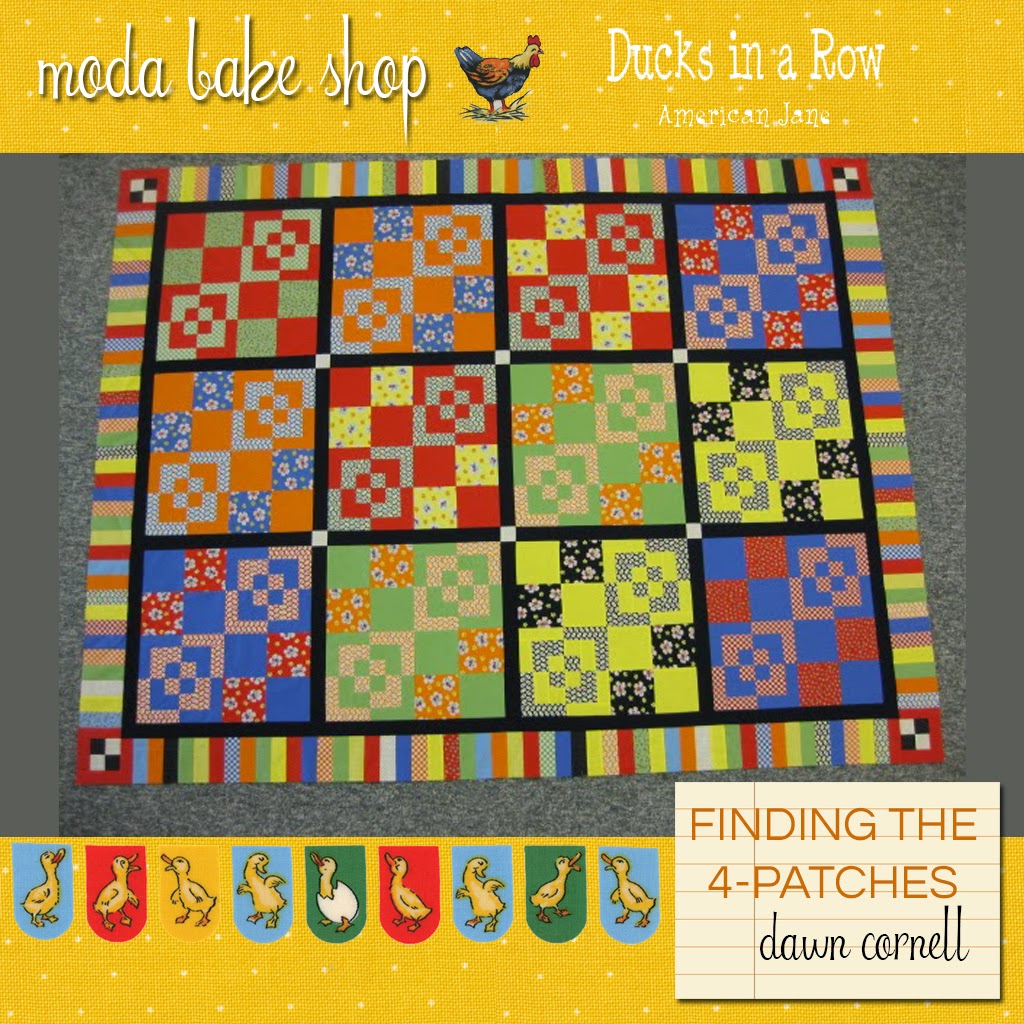
        Finding the 4-Patches Quilt


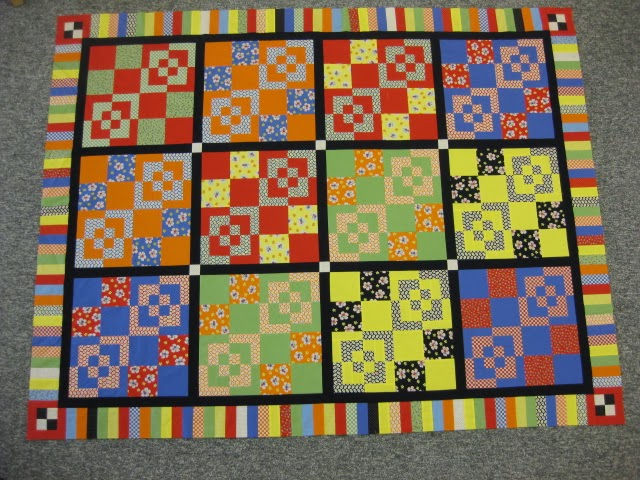
        Hi, I’m Dawn Cornell and today I have a cute quilt for you. It’s made with American Jane’s new line, Ducks in a Row. I call this quilt “Finding the 4-Patches” because it has a series of 4-patches in the main and secondary blocks. It’s all surrounded by a fun piano key border, making the most of two layer cakes and some beautiful Bella Solids.

        Ready? Let’s sew!

        2 Layer Cakes (I used “Ducks in a Row” by American Jane)
        ⅔ yard Bella Solids Lemon 9900-131, Green 9900-101, and Orange 9900-80
        1 yard Bella Solids Cayene (red)  9900-256 and Cobalt (blue) 9900-227
        1½ yards Bella Solids Black 9900-99 for sashing, border and binding.
        5½ yards for Backing (21650-11 multi is a good choice)

        Large 4-Patches
        Cutting

        From the Bella Solids (except the black), cut:

        • 2 – 10″ x width of fabric (WOF) strips from the Lemon, Green and Orange
        • 3 – 10″ X WOF strips from the Red and Blue

        Sub-cut these strips into 10″ squares, yielding 4 squares from each strip (for a total of 8 each lemon, green, and orange squares and 12 each red and blue squares)

        Cut all the leftover Bella Solids from this step into 2″ x 10″ strips to use in the border.

        Piecing the Large 4-Patches
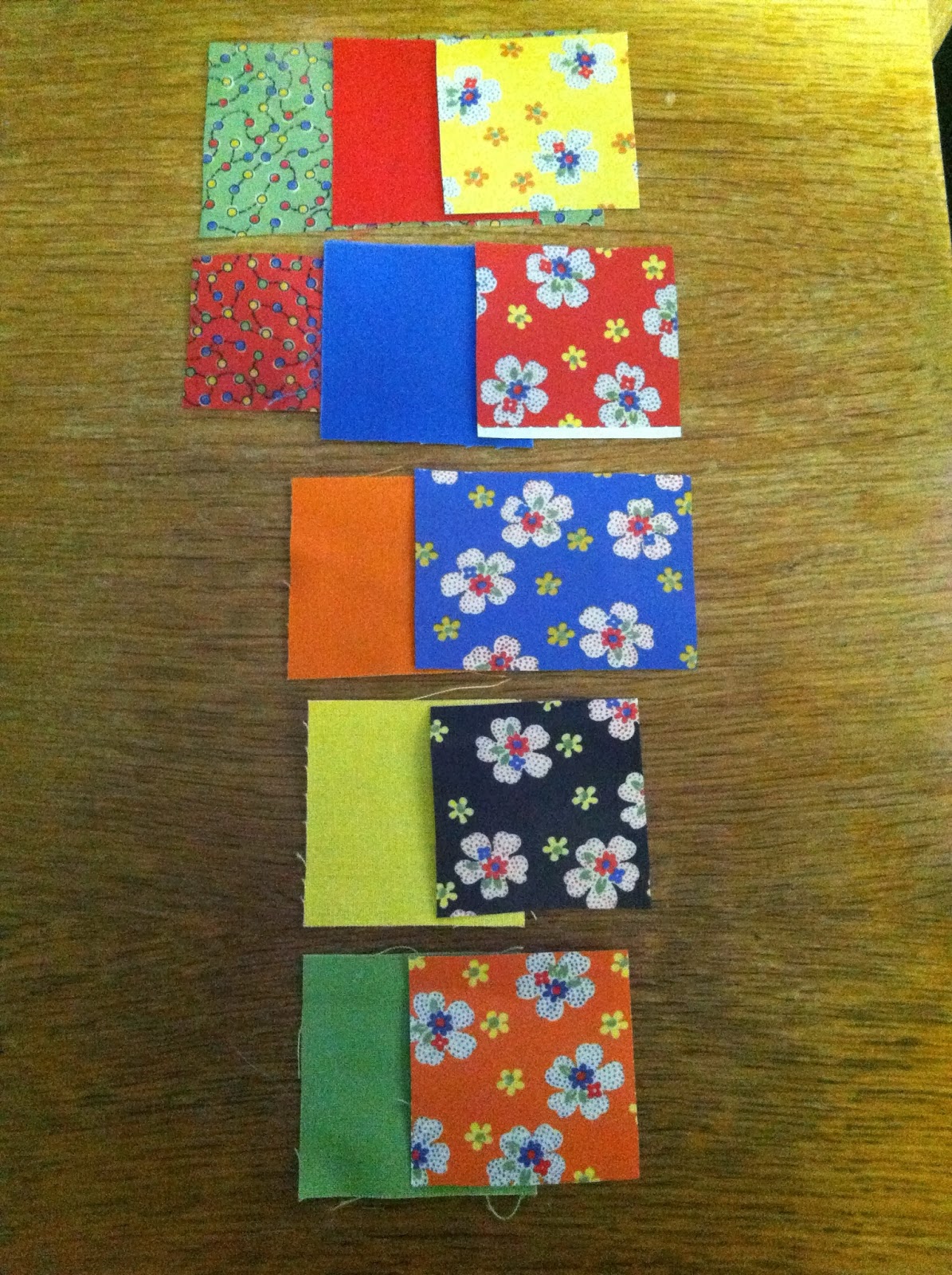
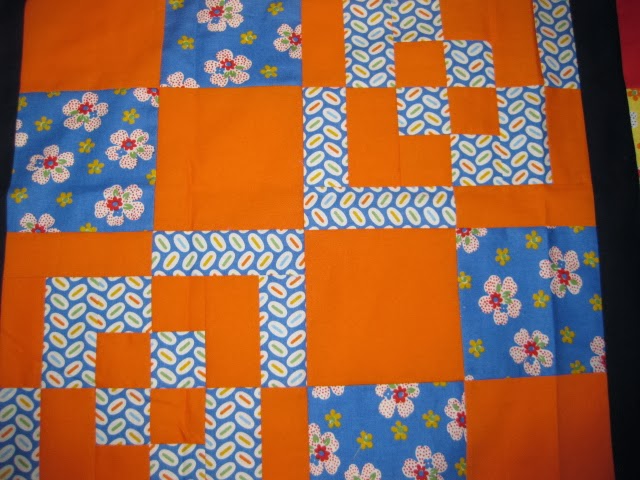
        Pair layer cakes with the solids as pictured below (each Layer Cake piece will yield 2 blocks).

        You will make:
        -2 red/green dot  and 4 red/lemon floral
        -2 blue/red dot and 4 blue/red floral
        -4 orange/blue floral
        -4 lemon/black floral
        -4 green/orange floral

        This combination will make a total of 24 large 4-patches.

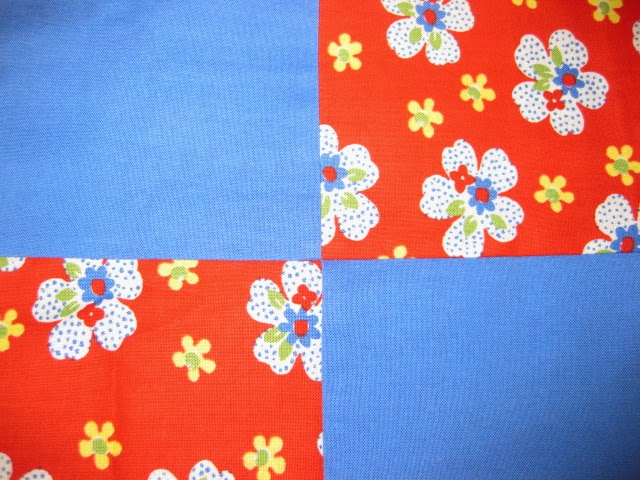
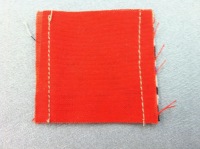
        This quick piecing method for large 4-patches yields two 4-patches from each set you sew…With right sides together and the solid on top, stitch along the two side raw edges. Cut in half (5″ from the raw edge, not the sewn edges) and press to the solid.

        Lay the two halves right sides together with the opposite fabrics touching and the center seam locking. Draw a line down the middle across the seam (5″ from the raw edge). Sew 1/4″ seam on each side of the drawn line. Cut on the line and voila you have two 4-patches. Press to one side and square to 9″.

        NOTE: If you set your ruler on the center seam at 4 1/2″, trim top and side, turn block 180 degrees and do the same, the block will square evenly.

        Pieced Blocks
        Cutting

        Pair the layer cakes with the solids as pictured below (each layer cake piece will yield 2 blocks).

        Make:

        2 blue/red check and 4 blue/red multi print
        2 red/green check and 4 red/green multi print
        4 lemon/black multi print
        4 orange/blue multi print
        4 green/orange multi print

        This combination will make a total of 24 pieced block units.

        Layer right sides together, solid on the top, cut each double layer into 2″ strips (each set will yield 4 strips 2″ x 10″)

        Repeat with each pair.

        From these strip sets you will sub cut:

        A – 2″ x 5″ strips

        B –  2″ x 3½” strips

        C –  2″ squares

        A segments: Right sides together and solid on top, sew each segment on the short end as shown in photo above. Press to the solid. Should measure 2″ x 9½”.

        B segments: Right sides together and solid on top, sew each segment on the long side as shown in photo above. Press to solid.

        Sew these segments together with the print on top and under the needle first.This makes an elongated 4-patch. Press to one side. Should measure 3½” x 6½”

        You will have a total of 48 – 4-patches when all sets are sewn

        C segments: Right sides together, solid on top, sew each segment together press to the solid. Now sew two segments together with the print on top and under the needle first to make a 4 Patch. Press to one side. Should measure 3½” square.


        You will have a total of 48 – 4-patches when all sets are sewn.

        Sew two 4 Patch units together with the solid on top and under the needle first. Press to one side. Should measure 3½” x 6½”

         
        Sew B units to top and bottom of  C units, right sides together along the 6½” side.

        Note:  The two fabrics under the needle should be the same and the center seam should lock.

        Press to one side. Should measure 6½” x 9½”.

        Sew A units to each side of the above units along the 9½” side.

        Note:  The two fabrics under the needle should be the same and the center seam should lock.

        Press to one side. Should measure 9½”. If not square up the same way you did the large 4-patches.

        Extra Large (XL) 4-Patches

        Make XL 4-patches using the Pieced Blocks and the 4-Patch Blocks. Are you keeping up with how many 4-patches we’ve made so far?

        Each of these 4-patch units should measure 17½” square and you will have a total of 12 XL 4-patches.

        Sashing and Borders

        Cutting
        Cut the Bella Solids black into 2″ x WOF strips. You will use 17 strips: 9 for sashing and 8 for the first border. Set aside the 8 border strips. Sub cut the 9 sashing strips into 2″ x 17½” strips. Yields 18 but you will only use 17.

        From the layer cake print (white with black and red dots) cut 6 –  2″ squares for the corner stones.

        Piecing
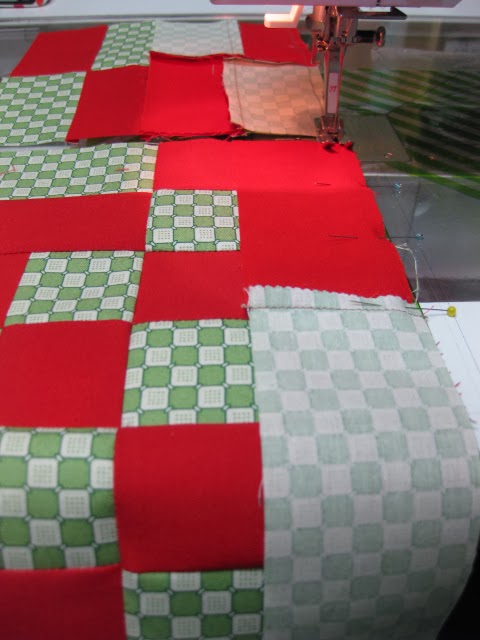
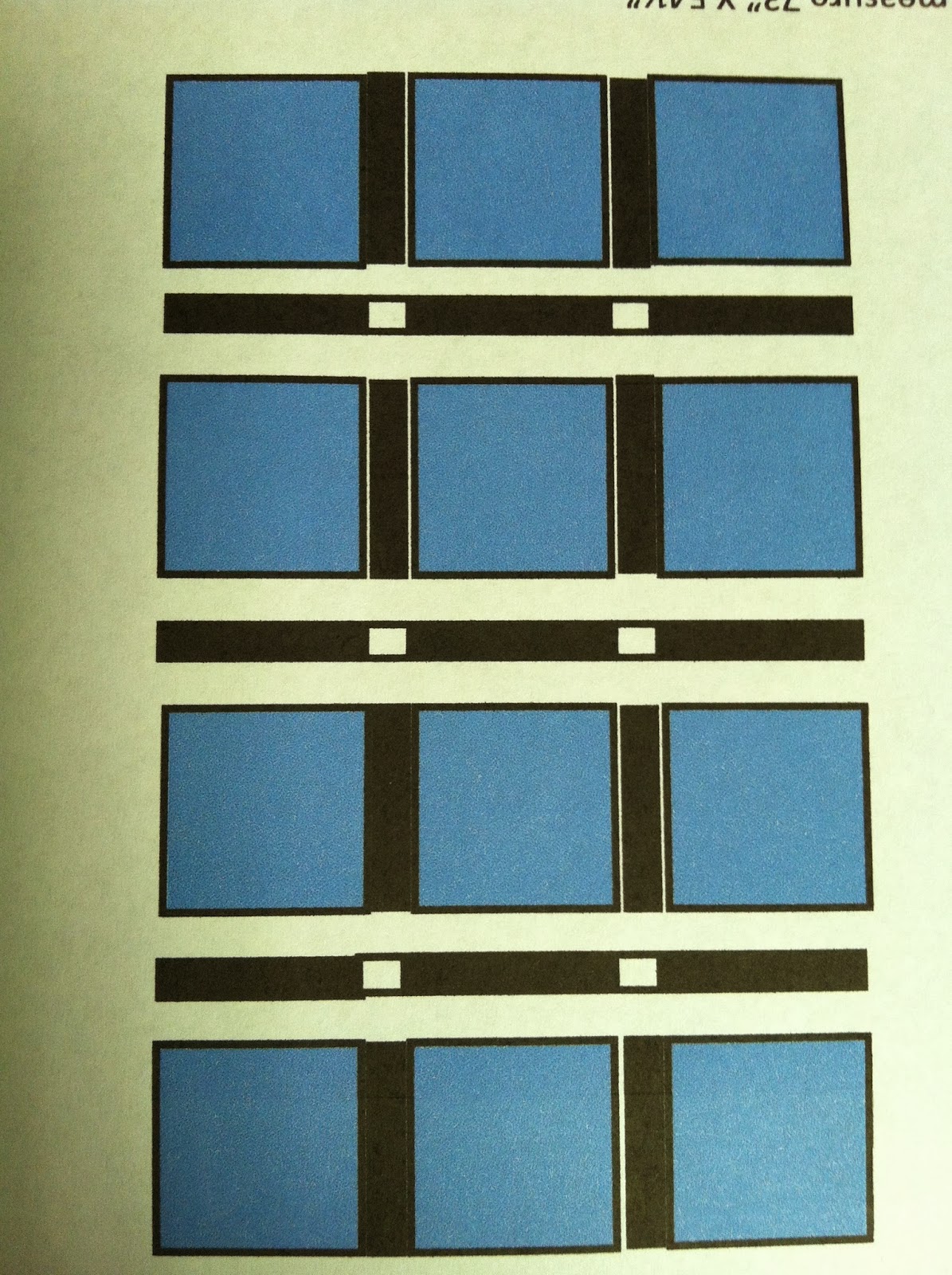
        Assemble the blocks, sashing, and corner stones in rows as shown below.

        When assembled should measure 73″ x 54½”.

        Making the First Border

        Sew 8 Bella black border strips in sets of 2 to make 4 strips measuring 2″ x approximately 86″. Cut 2 strips 73″ long and 2 strips 58″ long. Attach the long strips to the sides of the quilt top first. Press towards the strip. Add the top and bottom borders strips and press towards the strips. The quilt top should now measure  76½” x 58.

        Making the Second/Outer Border

        From your remaining fabrics, set aside 2 white with black and red dots layer cake pieces and 1 black WOF strip for the corner blocks.

        Cut all remaining 10″ squares from the layer cake and the solids into 2″ x 4½” strips. Piece together along the long sides of the strips, starting with red solid and ending with red solid.

        Solid + Print + Solid + Print etc.

        Piece together 51 total strips for each side and 39 total strips for the top and bottom. You may need to trim a little from each end to fit. Press strip sets and set aside.


        Making the 4-Patch Corner Blocks

        Cut the white dot and black dot layer cake squares into 2″ x 10″ strips (total of 5 strips from each layer cake square).

        Sew a white strip to a black strip along the 10″ side. Make 2 of these units. Press towards the black strip. Sub cut into 2″ x 3½” segments. Sew together in pairs to make 4 – 4-patches. (More 4-patches! Are you counting?)

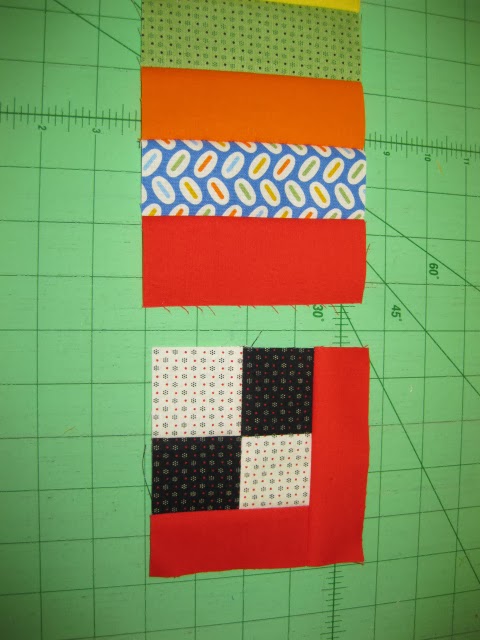
        From the solid red, cut 4 strips measuring 2″ x 3½” strips and 4 strips measuring 2″ x 5¼”. Sew a short strip to the bottom of a black and white 4-patch and along strip to one of the sides as shown in photo above. Square to 4½”, trimming only on the red solid fabric. Make 4 of these units.

        Attach the corners to each end of the top and bottom pieced border strips with the red to the outside.

        Sew the long pieced border strip on the quilt first and press to the first border. Add the top and bottom borders.

        If you are machine quilting, I suggest you stitch ⅛” seam around the out side edge of the border to stabilize the seams.

        Quilt, Bind, and Enjoy!


        76½” x 85″

        Oh, by the way, how many 4-patches did you find in this quilt?

        Dawn Cornell

        This Way Up?? Quilt


        Hello! This is Margie from Ribbon Candy Quilt Company with an easy, fun project today. Let’s get started.

        {Mixed Bag fabrics}

        11 Fat Quarters – 3 for the Center diamonds and 8 for the Arrows
        ¼ yard orange – top block
        ¼ yard yellow – bottom block
        1¾ yard blue for stop border and outer border
        ⅓ yard each of 4 fabrics for middle border
        ½ yard orange for binding
        4 yards for backing

        Here’s what I used:


        CUTTING
        From each of the 3 fat quarters that you are using for the center diamonds, cut one 12½” x 12½” square

        NOTE: Arrows 1-4 point up and arrows 5-8 point down.

        For Arrows 1 and 4, cut one 6½” x 8½” rectangle and one 6½” x 6½” square


        For Arrows 2 and 3, cut one 8½” x 12½” rectangle and two 6½” x 6½” squares

        For Arrows 5 and 8, cut one 6½” x 6½” square and one 6½” x 14½” rectangle


        For Arrows 6 and 7, cut one 12½” x 14½” rectangle and two 6½” x 6½” square

        PIECING THE ARROWS
        Sew Arrow blocks 1 -4 together in a row as shown and press seams to one side.

        Sew Bottom Arrows blocks 5 – 8 together in a row as shown and press seams to one side.

        Arrow Block sets:

        Now to make the Center Diamonds. Place your Center Diamond 12½” x 12½” squares in the order you wish them to appear in your quilt.

        Take your Arrow Point  1- 4….6½” x 6½” squares and lay them out as shown above.  Each Center Diamond will have a different fabric in each corner. Using a pencil, draw a diagonal line from point to point on the wrong side of each  6½” x 6½” square.


        Line up the raw edges in the top left corner and pin in place.  Sew on the pencil line. Press the Arrow Point square back and trim excess fabric.

        Repeat with all top arrow points. Here’s what your Center Diamonds should look like at this point.

        We are now going to work on the bottom half of the Diamonds. Lay out the Arrow Points 5 – 8 …. 6½” x 6½” squares as shown. Make sure you have the Arrow Point squares in order or your Arrows will not turn out.

        Repeat the process of drawing a diagonal line, sewing on the line, pressing, and trimming as outlined above.

        Continue to make your Diamonds and Arrow Points until you have all three Center Diamonds completed.

        Sew your Center Diamond blocks together in this order.  Press seams to one side. Layout your Top Arrow Block set and your Center Diamond set. Do you see the Arrows appear? 

        Match your seams and pin these sections together. Sew and press seams to one side. The top half is done! Repeat steps to attach the bottom arrow blocks.

        BORDERS
        For the first border, cut one 8½” x 36½” strip from each of two fabrics.


        Sew on the top and bottom borders as shown.  Press seams to one side.

        For the second border, cut 5 – 2½” x WOF strips. Set 2 strips aside for top/bottom border. Piece remaining strips end-to-end and cut into 2 strips measuring 50½” long. These are your side borders.

        Sew on side borders and press seams. Sew on top and bottom borders and press. At this point the quilt measures 40½”  x 54½”, a great size for a baby, just a thought.)

        For the third border, from each 1/3 yard, cut  2 – 6½” x WOF strips. Piece strips together, matching like fabrics. Cut middle borders as follows:

        • Side middle borders measure 6½” x 54½”
        • Top and bottom middle borders are 6½” x 52½”


        Sew on side middle borders.  Press seams to border. Sew on top and bottom middle borders.  Press seams to borders.

        For the fourth/outer border, cut 8 – 6½” X WOF strips.  Piece strips together end-to-end. Press strip and cut as follows:

        • 2 side outer border strips measuring 6½” x 66½”
        • 2 top/bottom outer border strips measuring 6½” x 64½”

        Sew on side outer borders.  Press seams to border. Sew on top and bottom outer borders.  Press seams to border.  DONE!!!

        Baste and quilt as desired.  I cut my binding at 2¼” x WOF.  You will need to cut 7 strips for binding.


        One Quilt finishes 64½” x 78½”

        ENJOY!!!!!

        Thanks for stopping by.

        Margie Ullery
        {ribboncandyquilts.blogspot.com}