subcut :
2 – 2½” x 36½” strips
3 – 2½” x 74½” strips
2 – 2½” x 78½” strips

Trish Poolson
{notesofsincerity.blogspot.com}


Trish Poolson
{notesofsincerity.blogspot.com}
![]()
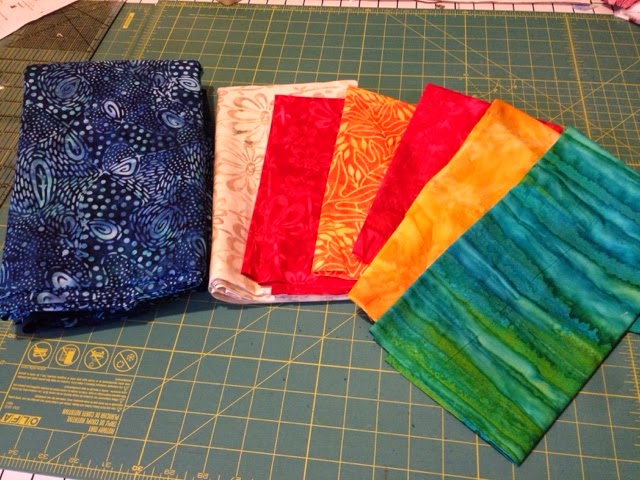
Hi, my name is Alison Tudor of Sew and Tell Quilts. Holiday Road was inspired by the Summer Vacation Batiks line and my love of 3D and geometric designs. I used yardage for my version, but fat quarters would make for a scrappier version.
Summer Vacation Batiks by Moda Fabrics
3/8 yd Ocean 4328-14
2-1/8 yds Ocean 4328-19
3/8 yd Sunset 4328-33
3/8 yd Sunset 4328-36
2-7/8 yds Sand 4328-41
3/8 yd Sunset 4328-35
1/4 yd Sunset 4328-32
4 yards backing fabric of your choice
1/2 yd your choice of binding fabric
68″ x 68″ batting
Foundation patterns

Cutting Directions
Piecing the Blocks
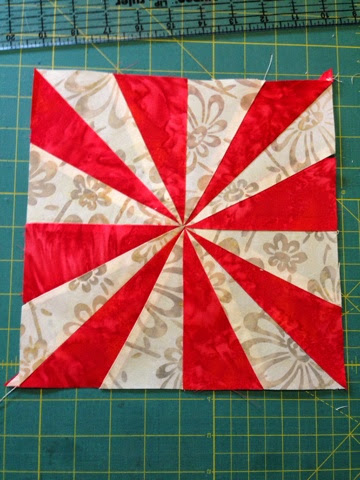
This quilt is made with two blocks. Block 1 is a paper pieced block. Find the templates {here}.
Block 1 Assembly:
![]() |
| Quilt Layout Diagram |
![]() |
| Holiday Road two tone |
Here is what this quilt would look like using just the blue and white for those interested. Yardage for quilt top would be 2-1/2 yards white, 3-1/8 yards blue. You might want to bump yardage up a bit to account for paper piecing.

Finished quilt = 65″ x 65″
36 – 9″ blocks
Alison Tudor
{www.sewandtellquilts.com}
![]()
Hi! I’m Julie from 627handworks.com. Today I’m sharing a Charm Party baby quilt with matching bonus pillow. I’m someone who likes to get as much as I can out of my fabric. The half square triangles leftover from the quilt top are perfect for creating a bonus project like a pillow or even a doll quilt. I would love to see your version if you make one!

2 Charm Packs – Print (Chance of Flowers)
1 Charm Pack – Solid (Bella Solid Snow)
1 1/4 Yards for Backing (Chance of Flowers, Cloud Flower Garden)
1/2 Yard for Binding (Chance of Flowers, Cloud Flower Garden)

To make the 16″ Pillow Cover you’ll need:
2 Yards of Trim
1 Fat Quarter (Chance of Flowers, Rose Sandy’s Solids)
18″ Zipper
Pillow Form
Gather up your fabrics. How pretty are these?
Pull:
Choose 4 different charms:
Take 2 of those charms and pair with a solid, right sides facing. Mark a diagonal line.
Stitch along your mark and sew another line 1/2″ over.
Cut between those lines. Set the smaller half aside.
Press open and arrange your HST (half square triangle) with the other 2 charms.
Stitch together.
Make 16 ‘mini-blocks’.
Take 4 mini blocks and form a large block.
Make 4 large blocks.
Sew the 4 large blocks together.
Take the 17 Charms we set aside earlier.
CUT:
1 Charm into quarters (4) 2.5″ squares
16 Charms in half (32) 2.5″ x 5″ rectangles
Take 8 rectangles and sew end to end creating a border. Make 4 borders.
Choose 2 of the borders and sew a square onto each end.
Attach the 2 border strips that do not have the square end charms.
Attach the two border strips that have the squares on each end.
You have completed the quilt top!
BONUS PILLOW
(OR you can also use the leftover HST’s to make a matching doll quilt)
Pull 25 HST’s leftover from making the quilt top.
We will be trimming these into 3.75″ squares.
If you don’t have a special HST ruler, you can use this method for trimming your squares.
Using Washi or masking tape, mark a line from corner to corner on the 3.75″ line.
(Make sure you are using the squared end of the ruler and one side isn’t an extra 1/2″ wide)
Lay your HST (still folded in half) with the seam line (NOT the raw edge) along the 3.75″ mark.
Trim
Press open creating a perfect 3.75″ square. Repeat for the rest of the HST’s.
Stitch together in 5 rows of 5 using any layout you like. Quilt if desired. Trim to 16.75″ square.
Sew decorative trim along the edge with the decorative part facing the center of the pillow.
Lay your zipper facing down, pillow front facing up, and stitch in place.
Cut your fat quarter into a 16.75″ square (or the exact size of your pillow front).
Lay your back piece facing up (edges aligned with the pillow front edges), zipper facing down, and stitch.
Open your zipper half way. Lay your pieces right sides facing. Pin all around the edges and and stitch, being careful not to catch your trim along the way. Zig-zag or overlock the raw edges to prevent fraying.
Pillow cover is done!

40″ Square Baby Quilt
16″ Pillow Cover
If you make a quilt I would love to see it!
Julie Hirt
627handworks.com
Hi! I’m Krista of Four Robbins Designs and I blog over at Sew What’s Cooking? I’m so excited to be sharing my first Moda Bake Shop project with you.
This is a fun, quick quilt using the beautiful Weeds collection by Me & My Sister Designs. My first design used Mixed Bag and it looked so fun I named it Sandbox. So this one is titled “Flowers in Sandbox”. I hope you like it!

Fabric:
17 assorted fat quarters – red (medium dark)
6 assorted fat quarters – black (dark)
5 assorted fat quarters – dark grey (medium)
5 assorted fat quarters – light grey (light)
3/4 yards solid – white (very light)
Binding – 1/2 yard
Backing – 4-2/3 yards

Use 1/4 seams through out. Be sure to cut largest pieces first and smallest last to insure you get all the pieces you need from your fat quarters.
Cut pieces as shown below:
Following the placement below, you will need to make 10 blocks.
Step One: Assemble pieces.
Step Two: Assemble center piece.
Step Four: Cut three of the blocks as shown below.
Step Five: Lay out blocks as shown below. Assemble by columns and then sew columns together to finish top. Please note: My finished quilt is shown upside down from this diagram with the smaller cut on top.
Here’s the back of mine. I had a fat quarter stack and extra solid. I cut strips of various colors and in various widths. I started in the center and then started adding strips in a spiral and then finished off with some wide solid.
Here is Sandbox using Mixed Bag by Studio M. I really love this for a child. I think it is so cheerful and fun!
One Sandbox Quilt 50″ x 80″ perfect for snuggling under.
Thanks for letting me share my quilt with you! I hope you like it!
Krista Robbins
Sew What’s Cooking?
![]()
Hello everyone! I’m Becky from Patchwork Posse. Today I am going to show you how to sew up the Turkey Tracks Lap Quilt Top. I love quilts….especially lap sized ones. They don’t take as long to sew up, are great for gifts, and are handy to have around the house for a quick snuggle and use.

1/2 yard- dark fabric
2 yard- background
1 1/4 yard- green
3/4 yard- red
various fabric scraps for the piano keys border- 5″ X 2 1/2″ –92
Dark Blocks~
36– 4 1/2″ X 4 1/2″ dark
36– 2 1/2″ X 2 1/2″ background
36– 2 1/2″ X 2 1/2″ background- corners of blocks
Flying Geese Blocks~
36– 5 1/2″ X 5 1/2″ background
108– 3″ X 3″ green
Sashing~
9– Red 2 1/2″ X 2 1/2″ squares
36– 6 1/2″ X 2 1/2″ background
Border~
2– 2″ X 43″
2– 2″ X 47″
Piano Keys:
92– 5″ X 2 1/2″ vairous fabrics
4– 5″ x 5″ corners- green

Dark Block:
Draw a line from corner to corner on the wrong side of the 2 1/2″ square
1) Place the small background 2 1/2″ square right sides on one corner of the 4 1/2″ dark square
2) Sew on drawn line, cut off remainder triangle and iron
Flying Geese Blocks:
Draw a line from corner to corner on the wrong side of the 2 1/2″ squares
1) Place the 2 1/2″ squares at opposite corners of the background square
2) Sew on either side of the drawn line
3) Cut on drawn line and iron
4) Place a 2 1/2″ square in the last corner of the background
5) Sew on either side of the drawn line
6) Cut on drawn line and iron
Square these to 4 1/2″ X 2 1/2″
Sashings:
1) Sew 6 1/2″ X 2 1/2″ on either side of a red 2 1/2″ square
Repeat for a total of 9
Set aside the remainder background pieces- will be used later
Piano Keys:
1) Sew 23 keys (5″ X 2 1/2′ ) side by side
2) Repeat for a total of 4
3) Sew the corner 5″ X 5″ squares to either ends of 2 sets- set aside
Block construction:
1) Sew single flying geese to the dark block
2) Sew the section from step 1 to the side of the block
Repeat until you have 36 blocks

56″ X 56″ Quilt
For more quilt tutorials and easy sewing projects– come stop by: www.patchworkposse.com
or follow me on Facebook at Patchwork Posse. You can also find me on Pinterest.
Hope you enjoy this quilt!
Becky @ www.patchworkposse.com
![]()
Hello! I’m Polly Monica from Aunt Polly’s Porch! I’m so happy to be posting here today at the always awesome Moda Bake Shop! I fell sewwww in LOVE with Moda’s Sewing Box collection and knew it would make some fun things for organizing any sewing room! I hope you think so, too! Let’s get busy making these eight sewing projects which include a sewing machine cover, a sewing machine mat, a versatile sewing caddy for your ironing board or armchair, a tub cover, a tie on pin cushion, a chatelaine, a square pin cushion and needle book.
1 Sewing Box charm pack
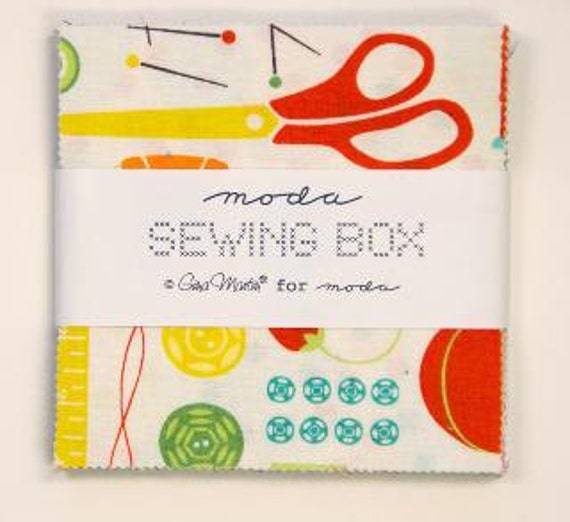
½ yard coordinating print # 1 (notions print white)

½ yard coordinating print # 2 (tape measure multi)
½ yard coordinating fabric #3 (pins lime)
1 yard coordinating print #4 (buttons blue)
1.5 yards fusible fleece
3.5 yards Jumbo rick rack
Assorted colors and sizes of buttons
ABBREVIATIONS and NOTES-
All seam allowances are ¼” unless directed differently.
RST = right sides together
RSO = right sides out
WOF = width of fabric (selvage to selvage)
Sewing Machine Cover Instruction
My sewing machine sits down in a Horne sewing table and it’s measurements are- 16” from right to left, 8 ½” from top of machine to tabletop, and 7 ½” deep looking at the machine from the side. (If your machine sits on top of a table, the height will be taller than mine!) You will need to measure your machine and adjust the measurements as necessary.
Take charm pack and cut all pieces in half, giving you two stacks of 42 pieces – 2 ½” by 5” rectangles.
Set one stack aside, now cut the other stack in half, giving you two stacks of 42 pieces – 2 ½” by 2 ½” squares.
Set one stack aside, take remaining stack of 2 ½” squares and select 16 for each side of the cover.
Lay them out in two rows of eight squares each (16 for each side).
From the leftover squares, select 4 for a four patch that will be made into a square pin cushion
And select 5 squares to be sewn into a row for a long skinny pin cushion.
Sew the two rows of squares for one side together- press seams in one direction on the first row and in the opposite direction for the second row so that the seams will nestle together when joined. The resulting long seam can be pressed to one side or open.
For the center panel on the cover, look at your fabric # 1. If the printed design is directional, like mine was, and you want it to be right side up on both sides of the cover, then you will cut two pieces that are 8 ¾” by 16 ½”. With RST, with the top of the design on BOTH pieces at the top, sew that 16 ½” long seam.
Now your design should be right side up on both sides of that center seam. If your print is NOT directional then you need no center seam and can cut one piece 17” by 16 ½”.
Sew one pieced set on each 16 ½” end. Press those seams toward the center panel.
![]()
Cut a piece of fusible fleece and your fabric # 2 for the batting / backing 18 ½” by 27”. Fuse the fleece onto the wrong side of either front or backing. With RSO, pin the sandwich and quilt as desired. I just did an all-over meander design.
If you wish to add rick rack or other trim, do it now! Some folks just stitch down the center of rick rack, which is fine with the narrow ones, but for the jumbo size, I like to sew close to the edge, down each side. Then trim off excess batting/backing.
For the ties, cut one 2 ½” by WOF strip of your fabric #3. Press it in half lengthwise.
Then open it up and fold the two long raw edges into the center fold and press again.
Topstitch closely down each long edge.
Trim off selvage ends, cut it into 4 equal pieces. Lay the cover over your machine and decide where you want the ties to go
and baste them onto the backing side with the raw end edge even with the side of the cover.
For the binding, measure the perimeter of your cover and add 8”. Bind the edges your way! Everybody has their own way of binding . I cut my strips 2 ½” by WOF. I join the strips with a diagonal seam, press in half lengthwise, and sew onto the front of the quilt with a SCANT 3/8” seam allowance, flip binding over the seam to the back and hand sew it down. But, the binding can be done your own way!
If you wish to add a handle at the top of the cover, cut two 2 ¾ ” by 7 ¼”pieces of your fabric #2. Cut one piece of fusible fleece 2 ¾” by 7 ¼”, and fuse onto the wrong side of one fabric piece. If you wish to add rick rack or trim on the handle, sew it onto that piece now.
I wanted my handle to be a bit more narrow at the ends, so I folded the pieces in half and cut off the corners- see pix below.
With RST, sew a ¼” seam all around the handle edges but leave an opening at least 2” to turn it through!
Turn the handle RSO through that opening and hand sew the opening closed. Topstitch 3/8” inch from all edges.
Measure the cover to find the center and mark it with a pin. Center the handle over that center, but build in a gap!
Sew through all layers, attaching the handle to the cover at each end.
I LOVE adding buttons to projects and especially stacking different sized buttons!!
Add them now wherever you want!! You could even add them down the middle of the rick rack, too!!
All done! Now stand back and admire your creation!!
Small Square and Tie-On Pin Cushions
Remember that fourpatch and row of five squares you selected and set aside back when you were picking out the squares for your cover front and back?
If you didn’t sew them together, do it now! Then lay them RST on top of a scrap of your fabric #1 which will be your backing, and cut around them.
Sew around all sides of the fourpatch, leaving a small opening on one side to turn it through.
Clip the seam allowance diagonally across the corners, but not too close!
This will reduce the bulk there and make those corner points look perfect!
Turn it RSO, fill it with your choice of polyfil or crushed walnut filler. I like the latter for pin cushions!!
I get it at the local pet shop- it’s cheap and is actually made for the bottom of small pet cages.
I save my twill tape ties from all Moda jelly rolls and bundles, so I cut my ties for the Tie-On pin cushion from one of those ties. If you don’t have any, you can make ties like the ones you made for the cover from fabric scraps or use ribbon you have in your stash. To determine how long to cut your ties, measure your machine as shown below.
Add 6” to that measurement. My machine measured 24” + 6” = 30”. So I cut a piece of the Moda twill tape 30” then cut that in half. Insert one end of each tie between the long skinny 5 patch and its backing.
Then sew all around the edges, but remember to leave a small opening to turn it through.
Turn it RSO through that opening, pulling out the ties, too. Fill both pin cushions al full as you like. On the skinny one, first fill it only partially up to the second seam line. Stitch through all layers at that seam between the second and third square to facilitate it fitting snugly around the corner on your machine, then fill it the rest of the way.
Sew the openings closed with tiny stitches.
Add stacked buttons in the center of the four patch pin cushion and at the sewn down seam on the tie-on pin cushion.
Voila!! Done!! Yaaaay!!
Tie the Skinny pin cushion onto your machine!! Add pins!
Cut a 16 ½” by 16 ½” piece of your fabric #4. Grab your stack of 2 ½” by 5” charm pack pieces, and select 8 pieces. Sew them together along the 5” sides. Press the seams open. Now cut this strip in half lengthwise giving you two strips that are 2 ½” by 16 ½”.
Sew one strip on each side of the fabric square you cut above.
Select 10 more strips, sew them together as described above, press seams open and cut in half. Sew one of the strips across the back of the piece. Set the other strip aside for now.
Now, select 10 more strips for the tall pocket layer, sew them together as above, press seams open, then lay that piece on top of your fabric # 4, and cut a lining strip that exact same size. With RST, sew down one long side. Turn RSO, press and top stitch 3/8” from seam edge.
Lay this pocket strip across the bottom of the mat with raw edges even all around and pin, then baste these raw edges together.
Now, stitch through all layers wherever you want to create individual pockets. Make sure to backstitch at the top edge of each pocket seam.
I made all my pockets the same size by stitching through all layers on every other seam line.
Next, take the half sized strip you set aside above that has 10 squares and cut out a lining for it from your fabric #4, exactly as you did it above. With RST, sew across the top edge, turn it RSO, press and top stitch it 3/8” from edge.
Lay it over the tall pocket strip on the lower edge of the mat, creating a second row of smaller pockets.
Baste the raw edges together on sides and bottom. Then sew through all layers again at seams to create the pockets.
In the photo above, the orange pins show where the tall pockets were stitched and the purple pins show where I chose to sew my smaller pockets. You can sew yours wherever you want!
Use this top to cut a piece of fusible fleece the same size. Iron it onto the wrong side of the finished top. Cut the backing from your fabric #4 just a bit bigger all around than the top. Pin the sandwich and quilt as desired, but don’t quilt through the pockets!!
If you want to add rickrack or trim, sew it on now!!
Trim the edges even and bind as desired using your fabric #3!
Hand sew the binding to the back of the mat! Taadaa!!
Done!! YAY!! Now set your machine on it and fill up those awesome pockets!!
Believe it or not, you still have some leftover 2 ½ strips from your charm pack, and you have scraps from your yardage we’ve been using, which you can cut into a few more 2 ½” by 5” strips if you want more variety!
Select 3 strips for pockets on one end of the caddy and 4 strips for the thread catcher on the other end of the caddy. Sew them together, cut a piece of fusible fleece for the four strip set, and fuse it on the back. Lay them both on your fabric #4, and cut a matching lining piece for each.
With RST, sew one long side together on both, turn both RSO, press seams and topstitch 3/8” from seam edge. On the four strip piece with the fleece inside, quilt it as desired.
Set both aside for the moment!
Cut 2 pieces 6 ½” by 18” from fabric # 4, and one piece the same size from fusible fleece.
Fuse the fleece on the wrong side of one piece. Layer RSO, then quilt as desired, creating the caddy base.
Align the three strip piece at one end and baste the raw edges on all three sides.
Then stitch through all layers on the 2 seam lines to create 3 pockets. Backstitch at the top of each pocket seam.
Align then baste the SIDES of the four strip set at the other end of the caddy base. Then pin the center bottom of the four strip piece to the center of the bottom of the caddy base and then make two small pleats as you pin the rest of the bottom edge of the four strip piece to fit the base.
Then baste across the bottom edge.
If you wish to add rickrack or trim, add it now!
Trim edges even and bind with fabric #3. Set aside.
Select 6 leftover 2 ½” by 5” strips for the caddy pin cushion.
Cut them in half creating 12 squares 2 ½” by 2 ½”.
Arrange them in two groups of 6 and sew each group together, leaving a small opening in the center seam of one group to use to turn it through later.
Place the two pieces RST, and using a ruler and pen, draw a line 1” in from each corner point and trim those corners off.
Now, sew all around the edges. Turn it RSO through the opening in the bottom seam.
Fill the pin cushion with polyfil or crushed walnuts and handstitch the opening closed.
I cut an 8” piece of rickrack and hand stitched/gathered one long edge and drew the thread up to create a ruffled flower.
I hand stitched it to the center of the pin cushion and added some stacked buttons, as well.
You can embellish your pin cushion as desired! Center the pin cushion in the middle of the caddy and hand stitch it through the back side to the caddy. YESSSSSSSS! All done!!
Now you can use it on the end of your ironing board and on an armchair in front of the TV!!
I wanted a tub to sit on my sewing table for sewing tools and materials. I had a large plastic 16 ounce Cool Whip tub container that was the right size! The circumference was 18” and the height was 5”.
Using the stack of leftover 2 ½” by 2 ½” square charm pack pieces, select 20 pieces and arrange and sew them together in two rows of ten squares.
If you want to add rickrack or trim, do it now!! I added rickrack down the center seam line.
Cut and fuse a matching piece of fleece to the back of it, then quilt it as desired. I grid-quilted it.
Cut a matching piece of fabric #4 for the lining, but make one end about an inch longer. Also, just a note here that for backings and lining and even batting/fleece, you can piece smaller scraps together when needed. I save small pieces of batting and connect them with fusible batting tape.
You will see this tape on the back of this tub cover!
Another tip is to trim off corners of seam allowance at points, as shown in photo below, to make them turn RSO better.
Sew two long sides and one short end seams- leaving open the short end with the longer lining piece.
Turn the cover RSO, topstitch 3/8” from the edges and fold up the longer lining end to enclose the raw edges and stitch it closed.
Pin the cover TIGHTLY around the tub, then slide it off. Sew it closed on the topstitch line of the finished end. I added a stack of buttons for embellishment, then slid it back onto the tub.
Another little project complete!! Yahoo!!
Line up 18 to 22 of your leftover 2 ½” squares in a long row. (Don’t forget you have some yardage scraps you can cut into 2 ½” squares to supplement your leftovers and provide a bit more variety.)
Sew them together, press the seams open then press it in half lengthwise
and use the same technique you used above to create the sewing machine cover ties to make a long topstitched piece.
Fold in one short raw edged end as you topstitch it, and slip in a 2” loop created from a bit of stash ribbon or thinner rick rack as I did.
Knot the other raw edged end.
Set aside for now. Select a green 2 ½” square, fold it in half then in half again and cut into a petal shape using pinking shears if you have them,
if not, just use regular scissors. Cut carefully from between two petals just to the center of the piece. Set aside for the moment.
Select 8 more 2 ½” squares and sew them into four patches. Lay them RST, and trim off the bottom corners creating a triangular shape with the narrow end at the bottom. This will become your strawberry shaped pin cushion. Sew all around leaving the top open. Using needle and doubled thread, sew a gathering stitch around the open top edge.
Turn RSO, and stuff with polyfil. Push the knotted end of the finished strip down into the polyfil and draw up the thread- gathering the raw edge tightly inside around the strip. Secure it with stitches and a secure hidden knot.
Wrap the leaf piece around the top of the strawberry and hand stitch it there.
Add some pins and needles, if desired!!
Sew on a small button a few inches in from the loop at the other end, so you can secure your small scissors there!! Well done! Another part of the set is complete!! You can wear your chatelaine around your neck while doing hand sewing in your favorite chair in front of the TV and never lose your scissors between the cushions again!!
After all this, I still had a few leftover 2 ½” by 5” strips, and I cut two more from yardage scraps.
Sew the four strips together. Cut and fuse a matching piece of fleece to the wrong side. Quilt as desired. Add trim or rickrack if you desire. Cut a 4” piece of stash ribbon or thin rickrack, fold into a loop and baste on the center of the back.
Cut a matching piece of fabric #4, or other yardage scrap, for the lining. With RST, sew around the edges leaving a small opening for turning.
Turn it RSO, hand sew the opening closed then topstitch around all edges.
Cut three 4” by 6 ¾” pieces of scrap batting .
Draw a line down the center with a heat erasable pen.
Line up this drawn line with the center seam of the cover.
Carefully flip it over and sew down the center seam from the cover side and through all thicknesses.
Erase the drawn line on the batting with a hot iron. Fold the book on that center seam line.
Add a button or two on the front allowing it to be secured with the loop from the back!
Add some needles inside and that’s it! You have completed the set of eight projects in this pattern collection!!
Pat yourself on the back and enjoy using your new sewing room creations!!
Eight sewing room essentials including a Sewing machine cover, a square pin cushion, a tie on pin cushion, a versatile caddy, a sewing machine mat, a tub cover, a chatelaine, and a needle book!
Thanks ever so much for trying out these projects! You may have spotted my sweet Westie – Yogi, in some of the photos!
Come visit us soon at my blog- www.auntpollysporch.blogspot.com!!
We’d love to have you come and visit!!
Polly Monica
{www.auntpollysporch.blogspot.com}
![]()
I hope you are having a great day. My name is Kris from krisrunner.wordpress.com and I am pleased to share this quilt with you today. At my house, the daffodils are blooming and the tulips are just around the corner. I wanted to make a flower quilt using a hexi design – and that is how this quilt came to be. I was surprised at how easy it was to use a half hexi template to make this quilt. I loved the colors in Chance of Flowers by Sandy Gervais and hope the great colors brighten your day as you make this quilt. This makes it easy to use with a charm pack or with jelly roll left overs or as a stash buster.


** All sewing will be done with a 1/4 inch seam.
1. Sort your charm pack into a couple of different piles.
16. Add batting and backing to your quilt top and start adding texture. Have fun!
![]()
Hello. Cindy Sharp from Tops to Treasures here again. I am excited about this quilt for a number of reasons, but mostly because its inspiration stemmed from the loving heart of my oldest son. Each step along the way was marked by the love of someone offering a good gift.
Good gift #1: Each person my son meets becomes a candidate for a quilt from mom. Really, he has no qualms about asking me to make one. I’ve made them for coaches, room mates, and class fund raisers. This time he asked me to make one for a pregnant friend.
Good gift #2: I was visiting with the ladies in the sample room at Moda and they suggested this line of fabric. “Mixed Bag” by Studio M is fun and funky, AND comes in brushed cotton….perfect for a snuggly baby quilt. Chelair tossed me a fat quarter stack and said “Send us the pattern when it is done!”
Good gift #3: I started Tops to Treasures in 2006 as a long arm quilting business. It pays for my quilty habit and helps my boys with college expenses. Sometimes I let my friends come and use the machine for the cost of the materials. (Honestly I love having company during the day.) Jeanne was not satisfied with that arrangement. Her solution….minion labor!! Jeanne volunteered to trade piecing for long arm time. I’ve seen her piecing…not going to turn that offer down. (Thank you my friend for piecing this quilt for me.)
So it went….one good gift leading to another. I hope you enjoy it as much as I did.
The horrible truth is that I am a bit of an OCDC geek. I love things to be orderly and in order. It makes me happy to see books arranged by subject and author on my shelf, earrings neatly paired in little cubbies, my Lego blocks sorted by size and color, directions that are explicit and precise, you get where I’m going.
The opportunity to make a rainbow quilt makes me “Happy, happy, happy!” just like the fabrics that inspired my design, Mixed Bag by Studio M.
All Good Gifts is a simple quilt made of 42, 8″ x 8″ finished blocks, set in a lattice of 2″ sashing with corner stones. The construction is straight forward and requires no special tools, or skills. The challenge lies in the selection and placement of color. With Roy G. Biv helping us, this should not be a problem.

The most challenging aspect of this quilt is the placement of colors. The picture below assigns a number to each diagonal row. All of the blocks in each row are identical. Use these row numbers and reference the following chart to determine how much fabric you need.
There is enough fabric in a fat quarter stack to make the blocks of this quilt; however, you need to purchase an extra fat quarter for the frame in each row that has more than 5 blocks. (Specifically, rows 1 and 2. They each have 6 blocks.)
In my quilt I chose to repeat the frame fabric used in row 1 (a long row) in rows 4, 9, and 12. This required additional yardage as well.
When making your fabric selections the following information is helpful:
|
Yardage Required
|
What I used
|
|
|
Blocks
|
FQ Stack *
*additional yardage needed for rows with more than 5 blocks
|
Mixed Bag by Studio M
|
|
Frames*
|
1/4 yd (row 1)
1/4 yd (row 2)
1/4 yd for duplicate frames
(rows 9, 12)
|
SKU#32860-11 SKU#32865-19 SKU#32860-11
|
|
Setting Squares
|
½ yd
|
SKU#32862-18 |
|
Sashing
|
1 3/4 yds
|
SKU#9900-97 |
|
Border
|
1 ½ yds
|
SKU#32865-19 |
|
Binding
|
1 yd
|
SKU#32862-18 |
|
Backing
|
5 1/4 yds
|
12 sandwich sized zip lock baggies

One very happy, 76″ x 86″ rainbow quilt to snuggle under or gift to someone you love.

Cutting Directions:
Before you begin cutting, it may be helpful to create a “swatch page” for your project. I’ve created a page for you, it lists all of the pieces you need to cut (just like the cutting chart) plus it has a column for swatches. Print this file Swatch Page with my compliments. In the column headed “SWATCH” cut and paste a small sample of the fabrics you want to use for that row. It will help keep everything organized – (read – this is so you know what you are doing when you finally get back to cutting out the project after the finishing 101 things that draw you away from your favorite hobby)
|
Row
|
# of Blocks
|
4 ½” x 4 ½”
Centers
|
8 ½” x 2 ½”
Frame
Top & Bottom |
4 ½” x 2 ½”
Frame Sides
|
|
1
|
6
|
6
|
12
|
12
|
|
2
|
6
|
6
|
12
|
12
|
|
3
|
5
|
5
|
10
|
10
|
|
4
|
4
|
4
|
8
|
8
|
|
5
|
3
|
3
|
6
|
6
|
|
6
|
2
|
2
|
4
|
4
|
|
7
|
1
|
1
|
2
|
2
|
|
8
|
5
|
5
|
10
|
10
|
|
9
|
4
|
4
|
8
|
8
|
|
10
|
3
|
3
|
6
|
6
|
|
11
|
2
|
2
|
4
|
4
|
|
12
|
1
|
1
|
2
|
2
|
I sure hope that was better than I am thinking it is. Right now it is “clear as mud” even to me. I suspect I am tired from all of that cutting….and maybe you are too.
Sewing Directions:
![]()

1 Mini Charm Pack – Print / Chance of Flowers
2 Mini Charm Packs – Solid / Bella Solid in Snow
3 Coordinating Fat Quarters
21″ Pillow Form

22″ Square of batting for quilting the pillow top
22″ Square of scrap fabric or muslin

Pull 40 printed charms and 64 solid charms.
Pair up 40 prints with 40 solids, right sides facing. Finger press a a diagonal crease on one side.
Chain stitch the 40 pairs of prints and solids on the diagonal crease.
Optional:
Without breaking the chain, run the the charms back through and stitch a 1/2″ over. Rather than throwing the trimmed fabric away, this quick step will create 40 little HST’s for future projects.
Cut. The pictures below show both options.
Open and press.
You should have a stack of 40 Half Square Triangles (HST) and 24 Solids.
Layout:
Using 12 HST’s and 4 solids, create a star.
Add the next row around – double check to make sure your HST’s are going in the right direction.
Add the points on the top and bottom.
Fill in with the remaining solid charms.
Piece:
Feel free to use your preferred method, I’ll show mine.
Some people like to stitch from the inside out, others in rows or even quadrants. This is how I piece several small squares that I want to keep in a certain layout and direction.
Going in vertical rows: Fold the squares on the right column onto the squares on the left.
Chain stitch – do not cut the thread between squares.
Feel free to press the seams, I don’t find it necessary and I will press later on.
Using the set of chained pairs, fold the first two pairs right sides together and stitch. Open. Fold the next pair up onto the previous pair and stitch. Repeat until all 8 pairs are pieced together.
Open and press the seams all in one direction. When you complete the next row, press those seams in the opposite direction. This will make it easier to piece the rows together.
Stitch the two completed rows together.
Stitch the other two rows using the same method, and sew the halves together.
If your edges are raggedy, feel free to trim a little and straighten them out. Just be careful not to cut off the HST points along the edge and leave a seam allowance.
Take a Fat Quarter and cut four 2.5″ strips down the length of the fabric. You will have four strips approximately 21″ wide.
Attach one strip to the top and one to the bottom of your block.
Press open and trim.
Attach the other two strips to the sides.
Press open and trim.
Optional: Using the batting and scrap fabric, quilt as desired. Trim.
Double fold:
Take your remaining 2 Fat Quarters and along the 21″ side, fold over 1″ and press. Fold over another 1″ and press.
Top stitch along the top and bottom of the fold. Repeat with the other Fat Quarter.
The Math:
The two back pieces will create an envelope style enclosure and they need to overlap about 4″. Since everyone sews 1/4″ seams a bit different, we may have slightly different sized pillow tops.
Take the width of your pillow top and divide by 2.
Add 2″.
You should be somewhere near 12″.
Trim both Fat Quarters to that measurement. Trim the raw edge opposite your double edge fold, leaving the 21″ width intact.
Example: My pillow top is 20″. 20 divided by 2 = 10. Add 2 = 12″. I now have two fat quarters that measure 21″ x 12″ each. (21″ side has the double fold)
Part 2:
Trim both Fat Quarters so they don’t hang off pillow top. Instead of being 21″ they will probably around 20″.
Layer:
Pillow Top right side up
Fat Quarter #1 right side down – lining up raw edges along the side
Fat Quarter #2 right side down – lining up raw edges along the opposite side
Pin or clip edges in place. Stitch along the edge all the way around.
Zip Zag or Serge the seam you created. This will help prevent fraying in the future.
Turn right side out and you are done!
I’m using a 21″ pillow form.

One pillow cover. If you make a Candy Flowers pillow cover, I would love to see it.
Julie Hirt
{627handworks.com}
Hi, my name is Trish and I blog over at notes of sincerity. Today I have a cute and simple quilt for you, made with Bartholo-meow’s Reef by Tim and Beck.

1 layer cake Bartholo-meow’s Reef (for blocks)
1/2 yard Bartholo-meow’s Reef Coral Glacie (for binding)
1.25 yards Bartholo-meow’s Reef Wave Water (for sashing and borders)
1/8 yard Bartholo-meow’s Reef Deep Water (for 30 corner stones)
4 yards Bartholo-meow’s Reef Deep Water (for backing)
cutting instructions
for corner stones :
cut two strips measuring 1.5″ x width of fabric
subcut into 30 – 1.5″ squares
for sashing :
cut 18 strips measuring 1.5″ x width of fabric
subcut each strip into 9″ strips you need 71
for borders :
cut 7 strips measuring 1.5″ x width of fabric
for binding :
cut 7 strips measuring 2.5″ x width of fabric
for backing :
cut the four yards in half (selvage to selvage)
for blocks :
choose 2 layer cake squares
sewing instructions for blocks :


of those 4 squares, pull one aside, cut one of the squares into fourths (you will have 4-2.5″ squares), cut the last two square in half horizontally (you will have 4-5″x 2.5″ strips)


58″ x 68″ throw quilt
Trish Poolson
{www.notesofsincerity.blogspot.com}