120-Minute Gift: Cinnamon Spice Tree Skirt/Table Topper


Hi there, it’s Cathy Victor from “Me and My Mum Quilting”, and I’m pleased to be bringing you my second Moda Bake Shop tutorial.  The great thing about this pattern is its versatility, you could swap out any 9″(9-patch) blocks for those that I’ve chosen.  Also you can make two tree skirts or table toppers from each layer cake.

So grab your favorite holiday layer cake and let’s get started…I am using the Blackbird Designs collection “Cinnamon Spice.”

As always I love to hear from you with your comments, questions and pictures.  You can find me at {Me and My Mum Quilting}
 

1 Cinnamon Spice Layer Cake (2700LC)
3/4 yd red fabric (2700-12)
1-1/2 yd Bella Solid (9900-60) {This includes enough for the table topper backing.}
Backing: 1 yd (2705-12)
Binding: 1/2 yd (2706-12)This is enough for both.


Ribbon
Decorative Buttons


For the tree skirt you need the following:

Greens: 
4 layer cake squares (a)
1 LC square (b)

Beige: 
2 LC squares (c)
2 LC squares (d)
1 LC square (g) middle square

Red: 
4 LC squares (e)
4 LC squares (f)
Approx. 1/4 yd of yardage

White: 
approx 1/2 yd of yardage

Cutting Instructions

Lay out the 4 (a) green squares and cut as follows:

Cut two {2} 2″ x 10″ strips from the bottom of the square

From the remaining piece, cut two {2} 2 5/8″ strips.

Subcut the previous 2 5/8″ strips into four {4} 2 5/8″ squares. Set aside the cut pieces until later; the leftover piece is not needed.

Next…from the Green square (b), cut two {2} 2 5/8″ strips…..

Subcut into four {4} 2 5/8″ squares. The rest of the fabric is not needed.

The Beige (c) blocks are for your hourglass blocks. From each of your two Beige (c) squares…cut from two {2} 4 1/4″ squares. The rest you do not need.

From your two Beige (d) squares…..Cut from each Beige (d) square three {3} 2 5/8″ strips.

Subcut into a total of 18: 2 5/8″ squares (9 of each fabric. You only need 16 so 2 are scrap. You do not need the rest of the fabric.

Go ahead and grab your 4 Red (e) squares…From the Red (e) squares, cut two {2}: 2 3/8″ strips.

Subcut into 8: 2 3/8″ squares (for each print). You will have a total of 32 squares. (8 in 4 different patterns.) You will not need the rest of the fabric.

The Red (f) squares are for the flying geese blocks and bricks. From your 4 Red (f) squares…cut a 2″x10″ strip from the bottom.

Then, from the remaining piece of each square, cut three {3} 2″ x 8″ strips.
There is a approx 4″ x 8″ piece leftover that you will not need.

Cut the bottom (2″ x 10″) strip and one of the 2″ x 8″ strip into four {4} 2″ x 3 1/2″ rectangles (bricks). Do this for all 4 prints for a total of 16 bricks. Set aside the remaining 2″ x 8″ strips until later. The rest you will not use.

Now grab the Red yardage. Cut two {2} 3 1/2″ strips. Subcut into four {4} 3 1/2″ x 10 5/8″ rectangles and four {4} 3 1/2″ x 5″ rectangles. (I cut out an extra 4 for the table topper, but if you aren’t making it don’t bother.)

From the White yardage, cut two {2} 2″ strips, one {1} 3 1/2″ strip, one {1} 3 3/4″ strip, and three {3} 2 3/8″ strips.

Subcut the 2″ strips into 9″ lengths.

Subcut the 3 1/2″ strip into sixteen {16} 2″ x 3 1/2″ bricks.

Subcut the 3 3/4″ strip into four {4} 3 3/4″ x 5 5/8″ rectangles.

Subcut the 2 3/8″ strips(3) into forty {40} 2 3/8″ squares.

Grab your remaining layer cake square (g) and cut it to: 9 1/2″ x 9 1/2″.

Assembling the Blocks 

So the first blocks to assemble are the flying geese blocks. Grab the 2″ x 3 1/2″ white bricks and the red bricks and strips that you cut from (f) LC squares. Also set aside the white 2″ strips and the green 2″ strips from (a). They will be coming up shortly.

The following pictures show how the blocks progress from beginning to completion….
You should now cut your red 2″ x 8″ strips into 2″ squares. You need 8 squares for each block and there are 4 blocks to make this tree skirt. That makes for 32 red squares all together.

Draw a diagonal line from corner to opposite corner. This is your sew line.

Place the red square on top of the white brick, and sew along the diagonal line, cut off the corner, leaving a 1/4″ seam. Press toward the red fabric. Place a matching red square on the opposite corner so that the line creates a point with the other red corner and sew. Cut off the corner, leaving a 1/4″ seam and press toward the red. You now have a flying geese block that measures 2″ x 3 1/2″.

Continue until you have completed 4 flying geese blocks of each pattern. Match these up with the bricks of the same color and pattern.

Sew the flying geese to the bricks so the seam crosses over the point of the flying geese block.
Press away from the flying geese block.

Next up green/white 4-patch blocks…..Grab the white and green 2″ strips and sew them together into twosie strips. Press toward the greens.

Cut the twosie strip into 2″ sections. Spin 1 section so that opposite colors are aligned. Matching seams, sew into 4-patch blocks. Press in either direction.

You will have a total of sixteen {16} 4-patch blocks (4 of each pattern).

Next up the hourglass blocks….Grab the 4 Gold (c) squares. They measure 4 1/4″ square and we are going to cut along both diagonal lines (from corner to opposite corner; in both directions)

Lay out the 2 patterns in the configuration shown in the picture.We will be sewing down the short side of these triangles first…..

Sew them all the same way, with the same fabric on top of the opposite color on the bottom. They all go through the same direction, do this until you have 8 pairs of triangles.

Press toward the darker of the 2 triangles.

This photo shows how the block progresses from a twosie triangle…Matched up with another… Matching seams and sewing to form an hourglass block. Press either direction …Trim off the dog ears, the block should measure 3 1/2″square.

You now have all the components needed to complete the first block…Match each pattern of red to a pattern of green and create an hourglass block as shown in the photo.

Lay out the above squares into the design shown in the photo. This will make 4 star blocks.
Sew them row by row and then press. I pressed away from my flying geese blocks.

This photo shows how they are pressed.

Go ahead and sew the rows into the final block, nesting seams and pinning if necessary. Press away from the middle row.You have now completed 4 blocks.

Grab the red 2 3/8″ squares and cut diagonally once from corner to opposite corner.
This will give you 64 triangles. (16 of each pattern.)

Do the same for the white 2 3/8″ squares…There are 80 triangles when you are finished.

Match up the red triangles with the beige 2 5/8 ” squares that were cut earlier. You can see in the photo that my green 2 5/8″ squares will be matched up with the white triangles.

Lay out the beige squares and red triangles, like the photo shows.

Make sure that when you line up the triangles you have equal amount of “dogears” on both sides. Go ahead and sew down the first side. Sew the opposite side the same way. Press the triangles toward the beige square. Trim off the dog ears and continue sewing the triangles to the remaining sides.

Press either way and trim off the dog ears. The photo shows how the block progresses.
Continue until you have completed all the red/ beige blocks.They should measure 3 1/2″ square.

Repeat the process with the green squares and white triangles. This photo shows how they progress.

You now have 4 piles of red/beige blocks and 4 piles of white/green blocks. Set them aside for now, we will return to them later.

Now take the red 3 1/2″ x 10 5/8″ rectangles, and carefully fold them in half lengthwise and press to make a visible crease. Next, cut a diagonal line from the bottom right corner to the crease line like in the photo.Then do the other side from the bottom left corner to the crease line (point).


With the white 3 3/4″ x 5 5/8″ rectangles, make 2 piles of 2. Cut diagonally once from bottom right to top left for the 1st pile.And cut the opposite direction (from bottom left to top right) for the other pile, like the photo shows.

Layout the pieces as shown in the photo.

Line up the white triangle with the red triangle point showing a little past the white, as shown in the photo.Your sewing machine needle should come down exactly where the 2 fabrics line up.

This photo shows how the blocks progress. Press towards the red fabric. Place the opposite white triangle in the same manner and press toward the red fabric.Trim off the dog ears.

The block should now measure: 3 1/2″ x 9 1/2″

Do this with all 4 red triangles. Set aside for now.

Next up grab the 4 red rectangles that measure: 3 3/4″ x 5 5/8″ and cut 2 diagonally from: top right to bottom left and,Cut 2 diagonally from: top left to bottom right.Set aside for now.

Remember these blocks? We will be assembling them into rows for the next step…Lay them out like in the photo, I put identical squares into the same block.(except for the central green/white square. it is from the extra pile of squares.) It is going to be the middle square in all 4 blocks.

Go ahead and sew them into rows.Make sure to match the points where they meet. You can pin them if you like.

This photo shows how I pressed the rows:I always pressed away from the white squares.Continue sewing all the squares into rows. BUT DO NOT sew them into larger blocks.

They are sewn together differently than normal to achieve the shape of the final tree skirt.

Next grab 1 of each pattern, the row shown in the photo….

And the red triangles we cut earlier.Lay them out like the photo shows with the flat side of the red triangles aligned with the bottom of the row of blocks.Sew them together and press toward the red triangles.

Next, grab the remaining rows of blocks….Lay them out exactly as the photo shows, making sure the fabric patterns match.Sew the rows together, making sure the bottom block is “pointing” to the other 2 rows.And that any points are aligned. Pin if they need a bit of help.Press toward the middle row.

 
You have now completed the other 4 blocks and are ready to assemble the tree skirt.

Grab the 4 blocks finished here and the 4 star blocks finished earlier and the Layer cake square that was trimmed down to 9 1/2″ and find a space to lay them out.

Lay the assorted blocks out, like the photo shows, moving the blocks around until you like the way they look.Sew them into rows, pinning where seams and points line up.Press away from the star blocks and central square. (doing this ensures the seams will nest nicely).

Next sew the rows into the nearly finished tree skirt, and get the remaining rows ready to add as borders.

Attach the border pieces to the sides, lining up the square in a square blocks and pin in place.
Sew the borders in place and press.

Now get ready to trace the hole for the tree stand.  I used a bowl for my template, you can use whatever makes the hole the size you like. Trace around the hole and straight through the middle of the tree skirt.(this bi-sects the square in a square blocks).


Quilt as desired…may I also recommend stitching around the circle you traced and down both sides of where the opening will be. This will ensure the tree skirt doesn’t shift while you are binding it.
Carefully cut the traced line for the opening and around the circle.

Your tree skirt should now look like this….

Get your buttons and ribbon out…..Place your buttons on the tree skirt, to decide where you want them. With a pencil, make marks on both sides of the opening for button and loop placement.

Cut your ribbon to 3″ lengths….

 Sew them in place along the opening with a scant 1/4″ seam that will be hidden in the binding.
I also pinned them down so they wouldn’t get caught up in the binding.

Prepare your bias binding strips and proceed to sew it around the tree skirt.

You may need to stop sewing and re-position the binding when rounding corners.
This is how it looks with the binding on.

Now I just sewed it down to the backside.( just make sure that you don’t sew the loops into the binding when you do this).

With the binding done, sew the buttons in the position you marked on the opposite side from the loops. You’ve completed the tree skirt!!!

Next up a table topper from the rest of the layer cake and fabric. It is the same pattern, just don’t cut out a circle and opening. I will list the substitutions for the fabrics, but follow the cutting and assembly instructions listed at the beginning of the tutorial by the letters in ().

Table topper substitutions…..
Pinks: 4 layer cake squares (a) (by cutting 5 – 2 5/8″ squares from each pink you eliminate step (b).) Leftover Red: 2 LC squares (c) hourglass blocks.
Approx 1/4 yd of yardage (4 – 3 3/4″x5 5/8″ and 4 – 3 1/2″x 10 5/8″ cut as per earlier instructions.)
Green: 2 LC squares (d)
Beige: 4 LC squares (e) 4 LC squares (f)

* For the whites, follow the cutting instructions below, but the assembly instructions above*
White:
2 Identical LC squares(4- 3 3/4″x 5 5/8″ rectangles)
4 LC squares (4– 2 3/8″ squares from each cut once diagonally to yield 32 triangles. Some of this can be leftover from previous.)
6″ yardage ( this section is for the 4-patch blocks and the flying geese units in the star block)
1 LC square for middle block (g) cut to 9.5″ square

Assemble the blocks as per the instructions for the tree skirt. But don’t cut the hole in the middle square or the slit for an opening. Quilt and bind as desired….


A Cinnamon Spice Tree skirt that measures approx. 33″ square. Perfect for any traditional Christmas setting.

A Cinnamon Spice Table Topper to compliment your Holiday decor. It also measures approx 33″ .

I hope you enjoyed this tutorial and that you will make one for yourself and maybe some loved ones too. Have a happy and healthy holiday season.

Season’s Greetings!

Cathy Victor
{Me and My Mum Quilting}

60-Minute Gift: Christmas Gift Bag

Christmas Gift Bag designed by Cathie Richardson of Country Garden Stitchery

~One charm pack of Fa-La-La-La-La by French General
~Three different fat quarters, two red and one natural, by French General
~Low Loft Batting
~Sewing Thread – I used a coordinating variegated red sewing thread.

For the embroidery:

~6″ x 9 1/2″ piece of coordinating quilting fabric for the embroidery design.
~Embroidery pattern (included in PDF print out)
~Three skeins of embroidery floss: one brown, one red, and one green.  I used hand dyed flosses by
The Gentle Art in Sarsaparilla #7015, Raspberry Parfait #0380 and Forest Glade #0190
~#02 Micron black ink pen.
~Tracing method of your choice.

For the embroidery trace the design onto the 6″ x 9 1/2″ piece of fabric using the method of your choice.  You can embroider the design in all one color for a redwork design or change the flosses to your favorite colors!  I will include here how I made the model.   Use two strands of floss except as noted.  Raspberry Parfait and stem stitch for the border lines, the snowman outlines and his hat.  For his face I used one strand of floss and stem stitch for his nose and mouth.  I used very small cross stitches for his eyes.  I alternated one and two strands for the stars in the sky.  For the dots use two-wrap French knots.  Sarsaparilla and back stitch for the lettering.  Stem stitch for the tree trunks.  Forest Glade and stem stitch for the outlines of the Christmas trees.  For the tree decorations Raspberry Parfait and back stitch.   When embroidery design is complete press lightly and trim the design down to 8 1/4″ x 4 3/4″ to where it has a 1″ border.
Use 1/4″ seams throughout.  Select five charm squares and cut five 2″ wide pieces.  Alternate the pieces to red-green-red and sew.  Press. Cut the sewn piece in half.  Select five more and cut 2″ wide pieces.  Alternate pieces to green-red-green and sew.   Press.  Cut sewn piece in half. 
From one of the red fat quarters cut a 2″ x 8 1/4″ strip.  Sew the embroidered design to a red-green-red patchwork strip, then add the solid strip, then a green-red-green patchwork strip.  Press.  From the same fat quarter you cut the strip cut a piece for the back measuring 6 1/2″ x 8 1/4″.  Sew a green-red-green patchwork strip then a red-green-red.  Press. 
From the other red fat quarter cut two 1 1/2″ x 8 1/4″ strips for back and front pieces and sew to the top and the bottom.  Press.  Cut two 1 1/2″ x 12 1/2″ for each side of front and back and sew.  Press.     
Cut two batting pieces the same size as the front and back and quilt as desired.  I used the variegated red sewing thread and a decorative machine stitch to sew around the edges of the embroidered piece and in between the strips on front and back continuing down the bottom of the back.   
With the third fat quarter cut two pieces the same size as the front and back for the lining.  Sew the outer bag front and back together.  For the lining sew the front and back together leaving a 3″ opening in the middle of the seam on one of the sides for turning.  From one of the red fat quarters cut two handles measuring 3 1/2″ x 18″.  Press the fabric strips in half lengthwise and then press down 1/4″ along the long side.  Sew the pressed edges together with the variegated sewing thread.      
To make the bottom edges turn the outer bag and the lining wrong side out.  Line up the bottom and the side seams on each side of both bag pieces.  Measure in two inches and put a pin in the spot until you have it lined up with the machine needle.  Sew a straight seam making a triangle.  Cut off the triangle pieces leaving 1/4″ of fabric before the seam.   
Turn the outer bag right side out and tuck it inside the lining so the right sides are together and the lining is on the outside.   Place the handles about 1″ from the side seams matching front and back and making sure they aren’t twisted.  Put the handle edges a little bit above the edge of the top of the bag to ensure they are included in the seam.  Pin in place.
Line up seams, edges of lining and outer bag and handles and pin in place.  Sew around the edge making sure to catch the handles.   
Turn bag right side out through the opening.  I always like to check to make sure my handles are secure and all fabrics were included in the seam before I sew up the opening.  Hand sew or machine sew the opening closed after pressing.
With the variegated sewing thread on the top and neutral color for the bobbin thread topstitch around the top of the bag.  Press.

One Snowman Embroidered Christmas Bag
9″  x  10″ x 3″ with 17 1/4″ handles.

Back View
A fun gift bag for the Christmas holiday!  You can adjust the size by adding strips and patchwork pieces.  Fill it with fun things for somone special then it’s useful after they’ve opened their gift! I’d love to see yours too ~ you can contact me with questions or comments through my website or facebook.  Thank you!  
Cathie Richardson

60-Minute Gift: Pet Mesh Bags

Hello all…it’s Jo from Jo’s Country Junction.  Recently I made a couple totes for my son so he could store his jumper cables and keep his league softball goodies all in one place.  Then my teenage daughter wanted a set too.  Being she is a cheerleader and our school colors are red, white and black, Sweetwater’s new fabric line, “Mama Said Sew,” was perfect.  She is using hers a lunch bag and a cheerleading bag. I thought I would share these great versatile bag patterns with you. They make a great gift  for just about anyone on your list!


Momma Said Sew Jelly Roll
Scraps of Deco Bond or heavy interfacing
Zippers  22″ red and 12″ red
Pet Mesh Screen:  This may be hard to find locally.  Here is an Amazon link for it:
New York Wire 70587 Pet D-Fence Screening, 36-Inch by 84-Inch

Let’s start by making the square bag.  Of course you can use it for many different things…storing your  grocery bags, packing a few goodies to take to the park, anything you can think of.

Start by unrolling your pet screening.  This is a plastic product.  Don’t worry about cutting it with a scissors or sewing with it.  It works wonderfully.

Cut:
2 ~ 12″ x 12″ pieces of pet screen
4 ~ 12″ x 4″ pieces of pet screen

Take your 12″ zipper.  Take your favorite black jelly roll strip and cut two pieces the length of the zipper.  Take a different jelly roll strip and cut two more pieces the length of the zipper.

Take one of each of the two different pieces and sandwich the zipper between them as shown making sure the right sides of the fabric face the zipper.  Make sure your favorite fabric piece is on the top of the zipper as it is the only fabric that people will see.


Pin in place as shown.

Sew along the pinned edge.

Press the fabric as shown.

Top stitch along the zipper.

Repeat for the other side of the zipper making sure the fabric that you want to be shown faces the top of the zipper.

Take a jelly roll strip.  Cut four pieces of fabric that are the width of the newly made zipper unit.  Sandwich two the pieces as shown, pinning in place.

Sew along the pinned edge using a 5/8″ seam.  Press and top stitch in place just as you did along the zipper.

Trim the edge of the fabric by placing the ruler along the edge and lining the 1 1/4″ line along the seam as shown.

Take a ruler and measure 10″ (the picture shows 11″ but use 10″).  Mark the line with a pen.

Tack the zipper as shown; sewing on the line previously made.

Trim the extra fabric away as shown cutting through the zipper.  Being the zipper is tacked, it is okay to cut it.

Sandwich the remaining two pieces of red fabric on the end.  Sew using a 5/8″ seam, press and top stitch as you did with the first end.

Trim the pieces so it is four inches wide.  It is easy to do this if you line the 2″ ruler marker along the zipper and trim.

Set this piece aside.  Now onto the handle.

Take a jelly roll strip.  Cut it 13″ long.  Cut a piece of Deco Bond  2 1/2″ x 13″.   Place the Deco Bond on the wrong side of the jelly roll piece and fold in half.  Pin.

Sew along the edge as shown using a 1/4″ seam.

Turn the piece right side out.  Press and top stitch.

Align the handles between the top of the zipper area as shown.  Tack in place.


Sew the 4″ x 12″ mesh pieces and zipper piece together as shown using a 5/8″ seam.

Bring the remaining zipper edge and the mesh edge together keeping right sides together.  Pin.  Sew using a 5/8″ seam.


Take the piece you just complete and one of the 12″ x 12″ mesh pieces.  Align it as shown pinning in place making sure the first and last pin is 5/8″ away from the edge.

Sew BETWEEN THE PINS using a 5/8″ seam.

Align the next edge.  Again pinning in place making sure the first and last pin is 5/8″ away from the edge. Sew BETWEEN THE PINS using a 5/8″ seam.

Continue on each side. Unzip the zipper.

Then repeat adding the other 12″ x 12″ piece.

Trim the corners.  Turn the bag right side out and you’re finished.

To make the long bag:
Cut one piece of mesh 24″ x 26″.

Make the handle using the directions above only this time make it 16 inches long.  Set aside.

Prepare a zipper using the directions above.  Please note that when using a jelly roll to make these, the pieces along the zipper will be different prints.  The zipper for this bag will not need to be tacked and cut.  It is already the right length.

Place the edge of the mesh along the edge of the zipper piece.  Pin and sew using a 1/4″ seam.

DO NOT TOP STITCH.

Bring the opposite edge of the pet mesh around aligning the wrong side of the zipper. Pin and sew using a 1/4″ seam.

Unzip the zipper half way.

Fold the bag as shown.  It should be about 14″ wide when folded so the zipper should line up at the 7″ mark or half the distance.  Pin and sew using a 5/8″ seam allowance.

Do the same for the opposite end.

Now it is time to box the corners.  Start with the end of the bag that DOES NOT have the beginning of the zipper.

Fold as shown,  Place your ruler and measure 2 1/2″ from the tip of the corner.

Cut the corner off.

Do the corner on the opposite side the same way.  The handle needs to be added first.

Now it is time to add the handle.  The handle is added as you box the corner.  Fold the bag the same way you did on the previous end only this time, slide the handle end in place.  Pin and sew.  I back stitched over the handle to make it more secure.  Clip.

If you look closely you can see the handle in between the mesh pieces under the seam.

Do the same for the other side.

Turn your bag right side out and you’re ready to go.

Two bags that are sure to make organizing your goodies just a little easier.

As soon as the bags were finished, our daughter put them right to use!

Stop over to my blog, Jo’s Country Junction, and see what I’m up to now.

Jo Kramer
{joscountryjunction.com}

30-Minute Gift: Simply Colorful Coasters


Are you ready for a quick and easy gift idea? I’m Amy DeCesare from  Pennsylvania, and I’m so happy to be the newest chef here at Moda Bake Shop! My blog is called Amy Made That!…by eamylove and I hope you’ll pop on over to visit me there. {You’re welcome to stop by any time!}

Today I’ll show you how to make a charming set of coasters to give as cute and practical gifts. These little sweeties stitch up quickly! Once you’ve gathered your materials, you can make a set in about 30 minutes. They would make an excellent project for a beginner or even a child.{I’ve been sewing for years, and I can’t stop making these. The design possibilities are unlimited!}

1/3 yard Bella Solid fabric {I chose Gray}
(8) squares from a Moda Charm Pack OR(8) 3″ squares from a Moda Layer Cake {I chose a Simply Color Layer Cake}
1/4 yard fusible interfacing, such as Pellon 987F


Matching thread
Iron and ironing surface
Pinking shears

Cutting:

First you will need to select your prints.
I chose to use the blue and green colorways from my layer cake.
{You could make all 8 coasters the same, or all different to coordinate.}

From solid fabric, cut background and backing pieces:
Cut (2) strips 5” x WOF
Cut each 5” strip into (8) 5” squares, for a total of (16) 5″ squares.

From the charm pack or layer cake, select (8) prints, and cut each into a 3” square.

Cut (8) 3” squares.
Cut one strip 5” x WOF: Cut into (8) 5” squares.

Fuse the Pellon 987F as follows, using manufacturer’s directions:

Fuse one 3” square to the back of each charm print, for a total of 8 coaster centers.
Fuse one 5” square to the back of each of (8) of the solid  5” squares, for a total of 8 background squares.

{The remaining (8) solid 5” squares will not have Pellon 987F fleece fused to them.}

Center one of the 3” squares on one of the background pieces which have been fused with the 987F fleece. Pin the 3” square into place.

Using a straight stitch, take a few stitches very close to the edge of the charm square.

Switch to a zigzag stitch (or another decorative stitch) and sew around all 4 sides of the charm square.  When you arrive at the starting point, change back to a straight stitch and backstitch to secure the stitches.

Now layer your finished square on top of a bottom solid square. {Your coaster will not require any turning, so place the squares just as they will appear when the project it finished.} Using a straight stitch, sew ¼” all around the outside edge of the coaster, through all layers.  Backstitch at the end to lock the stitching.

Repeat these steps to assemble the remaining coasters.

To finish, use pinking shears to trim near the stitching on all four sides.

Look how cute and cushy they are, all stacked up…

Or all fanned out! Which one will you choose?

Use a beautiful ribbon or a fabric strip to tie your coaster set for a pretty presentation.  I used pinking shears to cut a ribbon of Bella Solid 1″ x WOF.

 8 colorful and fun coasters

Don’t forget to make a set for yourself! And speaking of gifts….head on over to my blog Amy Made That!…by eamylove for a chance to win my latest giveaway!

Amy DeCesare
{eamylove.blogspot.com}

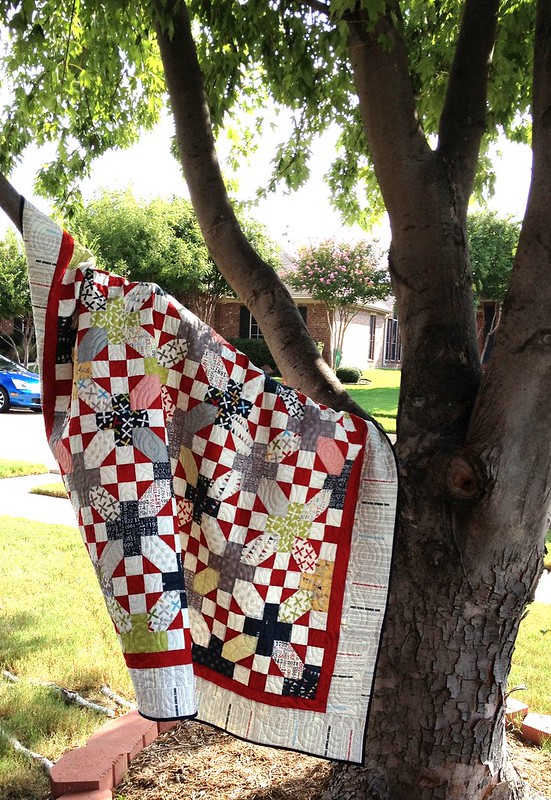
"Nough Said" Layer Cake Quilt


My daddy was a quiet man who loved the out of doors. He had an uncanny ability to connect with people on a personal level. It still amazes me how he could sit down with someone and within 10 minutes share a bond that reached to their deepest roots. It amazes me, but it isn’t really a surprise. Daddy designed camps. Anyone who ever spent time at a Boy Scout or Girl Scout or Church Camp, anyone who ever drove through a national park or enjoyed the view from the top of a mountain or the side of a lake stood where my Dad stood. He would share that moment with you…in detail…because he had been there.

When Dad met my beloved he knew exactly where G had grown up. The man could describe the drive way and the house and where the trees were planted. Dad had been past it a hundred times on the way into the Sierra National Park.

I have no doubt that he could do it with you, too.

To me, this quilt is all about that – connections. I made it with Reunion by Sweetwater…a fabric line about connections….+’s and x’s connect numbers……the blocks form chains….you get the picture….. ‘Nough Said.

  • 1  Layer Cake (42 10″x10″ charms)
    • for +’s and x’s  
    • I used Reunion by Sweetwater
  • 1 1/2 yards Red
    • for inner border, sashing, and x’s
    • I used the red from A Stitch in Color by Malka Dubrawsky (#23210 16)
  • 1 yard Cream  
    • for sashing
    • I really don’t know what I used, I wasn’t paying attention when I bought it, but you could use Porcelain from Bella Solids (#9900 182) and get the same result.
  • 1 1/2 yards Outer Border
    • I used the news print on porcelain from Reunion (#5471 13)
    • My original plan was to use the grey with dandelion dots (#54762 1)
My original idea for this quilt

  • 4 yards Backing
    • I have to admit it….my taste changed a little between the time I bought the fabric and the time I finished the quilt.  I bought grey chevrons (#5473 1) as my outer border and the news print (#5471 13) as my back.  When I got to the point of adding my borders, I didn’t like that anymore.  So I used the fabric I had on hand for the backing to make the borders.  As a result my backing wasn’t big enough.  What you see is the remainder of my original backing plus 8 charm squares and some of the chevrons.  I kind of like the results.
    • All of this to say – go ahead and be creative!

  • 1/2 yard dark blue
    • for binding
    • Again, I have no idea what I used.  It is dark blue.  Bella Solids, #9900 174, American Blue would do the trick.

This quilt can be viewed in a couple of ways.

It might be 64, 4″ blocks set in an 8 by 8 grid with 2″ sashing all around.  This view helped me a great deal when I was cutting things out.  Not so much when I was piecing it.  (I get intimidated by large numbers.)

A friendlier view is 16, 10″ blocks set in a 4 by 4 grid with  2″ sashing all around.  From this perspective it kind of looks like the “+’s & x’s” quilt that is so popular in blog-land.

Cutting Instructions:

  • From Red
    • Cut 10, 3 1/8″ x width of fabric (wof) strips
      • Sub cut into 128, 3 1/8″ x 3 1/8″ squares
    • Cut 5, 2″ x wof strips
      • Set aside for inner border
    • Cut 3, 2 1/2″ x wof strips
      • Sub cut into 40, 2 1/2″ x 2 1/2″ squares
  • From Cream
    • Cut 9, 2 1/2″ x wof strips
      • Sub cut strips into 144 2 1/2″ x 2 1/2″ squares
  • From Layer Cake
    • Divide cake into a pile of lights and darks
    • From lights
      • Select 16 charms
      • Cut each charm into 4, 5″ x 5″ squares
    • From darks
      • Select 13 charms
      • Cut each charm into 16, 2 1/2″ x 2 1/2″ squares
      • Keep these squares in sets of 5 matching squares.  They will become +’s later on.
      • Yes, you will have extras.
  • From Outer Border
    • Cut 6, 5 1/2″ x wof strips
      • Set aside for outer border.

Break time!!!  If you have worked all the way through the cutting you need a break.  Go for a walk.  Call your Dad just to say hi.   Pet the dog.  Stretch.  The quilt will go together much more smoothly this way.  Trust me.

Piecing Instructions:

  • 64 Little blocks (& 128 bonus half square triangles)
    • Gather
      • 128, 3 1/8″ x 3 1/8″ red squares
      • 64, 5″ x 5″ light squares from layer cake
    • Draw a diagonal line on the wrong side of each red square
    • Align one red square and one light square, right sides together so that the diagonal line is parallel to the corner.

    • Sew just to the outside edge of the drawn line….closer to the common corner.

    • This step is optional  – I hate tossing extra bits of fabric.  So I’ve included this step.  Call it a bonus block.  Hope over to my blog and see what you can do with them.
      • Draw a second line 1/2 inch to the outside of the stitching you have just done. (the green line)
      • Sew just to the inside of this line…between the blue and green lines along the green line.
      • When you have a minute head over to my blog to see what I did with my bonus blocks.
    • Cut excess, 1/4″ from sewn line between the line and the aligned corner (or between the two sewn lines if you made the bonus hsts).
    • Iron seam allowances toward the red.
    •  Repeat on opposite corner.
    • Trim blocks to 4 1/2″ x 4 1/2″
  • 16 Bigger blocks
    • Gather:
      • 64 little blocks
      • 64 cream 2 1/2″ x 2 1/2″ squares
      • 80 dark 2 1/2″ x 2 1/2″ squares (16 sets of 5 matching squares)
    • Sew each cream square to a dark square.
      • 16 dark squares will be saved for the centers.
    • Iron seam allowances towards the dark squares
    • Keeping dark sets together, and scrambling the light patches in the little blocks, combine patches to make 16 bigger blocks as shown above….more or less, your fabrics will all be different.
  • Connector Units:
    • Gather
      • 80 cream 2 1/2″ x 2 1/2″ squares
      • 40 red 2 1/2″ x 2 1/2″ squares
    • Sew 40 red squares to 40 cream squares.
    • Iron seam allowances toward the red.
    • Sew 40 cream squares to the red/cream units, parallel to the seam just sewn, making 40 units that are cream, red, cream.
    • Iron seam allowances toward the red.
  • Rows:
    • At this point it is very helpful to use a design wall….or floor….or bed.  The idea is to find a place where you can set  your blocks out and see what you are doing.
    • Gather
      • 16 big blocks (BB)
      • 40 connector units (CU)
      • 25 sets of 5 matching dark 2 1/2″ x 2 1/2″ squares (DS)
    • Arrange 9 alternating rows starting and ending with a sashing row.
      •   At this point I found it easiest to pin the dark squares as a unit of 5, taking them off and adding them to the rows as I needed them.
      • 5 sashing rows
        • 2DS, CU, 3DS, CU, 3DS, CU, 3DS,CU, 2DS 

      • 4 block rows
        • DS/CU/DS, BB, DS/CU/DS, BB, DS/CU/DS, BB, DS/CU/DS, BB, DS/CU/DS
    • Sew 5 sashing rows,
      • ONE at a time to keep things in the right order
      • Don’t worry about ironing your seam allowances just yet.
      • Return each row to design wall/floor/bed as you finish it.
    • Sew 20, DS/CU/DS units together

      • Iron seam allowances toward the DS
      • Return units to your design wall/floor/bed
    • Sew 4 block rows
      • ONE at a time to keep things in the right order
      • Ironing seam allowances towards the DS/CU/DS units
      • Return each row to design wall/floor/bed as you finish it.
    • Sew rows together.
      • Push seam allowances in sashing rows so that they snuggle with the block rows appropriately.
      • Iron seam allowances when finished.

  • Inner Border:
    • Gather
      • 5, 2 x wof red strips
    • The following directions describe how I attach borders.  With gentle handling this works just fine.  If, however, you are apt to tug on your fabric as you sew measure your top and use the binding strips to make 4 long strips of the exact lenghts you need before you sew them on. Skip the rest of this section and proceed to your outer borders which you will do the same way.
    • Sew 2 strips, end for end along short side.
    • Iron seam allowance open
    • Attach this strip to one side of the top.
    • Iron seam allowance toward the border strip.
    • Trim excess
    • Sew excess, end for end along the short side to a wof strip
    • Iron seam allowance open.
    • Attach this strip to side parrallel to the border you have already added.
    • Iron seam allowance toward the border strip.
    • Trim excess
    • Repeat process on other two edges.
  • Outer Border:
    • Gather
      • 6, 5 1/2″ x wof strips of border fabric
    • Refer back to inner border instructions.
  • Layer and Quilt as desired.

I hope you enjoy your quilt!  Please take a photo of it and add it to my group on Flickr.  Feel free to visit me too…there are lots of other fun things going on over at Tops to Treasures.

67″ x 67″ throw, perfect for watching a ball game or snuggling under while reading a good book.

Cindy Sharp
{topstotreasures.blogspot.com}

30-Minute Gift: Padded Steering Wheel Cover


 I’m Sarah from Sweet Dreams by Sarah, and I am incredibly excited to be sharing my first Moda Bake Shop tutorial with you for this fun steering wheel cover!  I live in the insanely hot Arizona desert, and there are frequently times in the summer when it’s impossible to grab the steering wheel.

This cover serves to help keep that problem at bay, as well as making it much easier for those winter months when clutching a freezing cold steering wheel can make your hands ache.  It’s also completely customizable, since it’s perfect for any set of charms you might have lying around! It makes a lovely gift, too.

Please also stop by my blog for other tutorials and adventures in quilting!

10 Charms of your choosing (I used Flirt by Sandy Gervais for Moda)
1 piece of backing fabric measuring approx. 48″ by 5″
1 piece of Insul Bright Heat Resistant Batting measuring approx. 46″ by 3.5″ (Side note: if you aren’t worried about your steering wheel being too hot, and you just want it to be padded, you could use regular cotton batting in place of the Insul Bright)
2 lengths of elastic, measuring approx. 32″
4 safety pins, no bigger than about 1″ long.
Optional, but helpful: Basting spray

The first step is to measure your steering wheel!  The measurements that I will be working with are for my 14.5″ steering wheel, which is a pretty standard size.  If your wheel is a different size, your first step is going to be to measure around the circumference of the outside of the wheel.  For me, this measurement is 46″, and it will be come the length that you will need both the piece of backing fabric to be as well as the piece of batting.  Also, take this measurement and subtract 14″ – this is the length that you will need your lengths of elastic to be.  If your wheel measures more than 46″ around, you may also need to add one more charm to the first step below – see the note in that step for help with the modification.

Now that we know what we’re working with, it’s time to dive into the fabric.  Pull out your charms, and line them up.  Arrange them in the order in which you want to see them going around your wheel, and remember that this is going to be a circle – the first and last ones are going to connect to each other.

Sew the charms end to end with a scant quarter inch seam, and press the seams to one side until you have one long strip:

*Side note for larger sizes:  You’ll want to sew extra charms end to end here, so that you have a longer strip of fabric to work with.  For instance, upping it to 11 charms yields a strip about 50″ long. You can then trim it down if, say, your circumference is only 48″.  Just be careful not to trim it too short – the elastic makes having a slightly bigger wheel cover very forgiving.

Prepare your backing fabric next!  There are lots of options as to how to do this.  You could actually use another 10 charms, if you want it to be reversible (see side note above if you have a larger steering wheel).  Just follow the steps above to connect them all together.  You could also cut two 5″ strips from yardage, sew them together end to end, and then cut down to length.  The first time I made this, I actually used a scrap piece of quilt backing that I had trimmed off of a quilt I’d made just the week before, so feel free to be creative!  This is just the backing, so if you aren’t worried about making it reversible, you can use just about any piece of fabric that meets the measurements.  For this particular cover, I used one 5″ strip of backing fabric, and sewed one extra charm to the end to get the right length.  Note that the length of the backing is a couple of inches longer than the strip of charms – this gives you a little wiggle room to cover up the final seam.

The strip of charms for the outside is on the left, and the backing is on the right.

Putting it all together:

Position your backing fabric and the strip of charms right sides together, and making sure that the edges are aligned.  Pin these pieces, and then sew them together lengthwise:

Now we need to turn the long tube we just created inside out, and get the batting in the middle.  There are a couple of ways that you can do this.  One option is to turn it inside out, press it flat, and then try to wiggle the batting up the middle.  You would then just pin the batting in place before moving on to the next step.

The other way to do it, and how I did it when making this particular cover, is to use some basting spray as a helping hand.  Once you’ve sewn the cover and backing together, and before you turn it inside out, spray baste the batting to the charm side of the strip, like this:

Spray the batting, and lay it down the center (you can just eyeball it).  Make sure you press the batting on well, and then go ahead and turn it inside out.  Be gentle so that you don’t separate the batting from the fabric.

I found it easiest to hang on to the batting and fabric together on one end with my left hand: 
… while pinching the fabric and batting together and pulling it out with my right.  

Ta da!

Once it’s inside out, go ahead and press the tube and batting combo so that it’s all nice and flat.

Now, whichever way you’ve gotten your tube inside out and batting inside, it’s time to make the casings for the elastic.  Sew down the length of the tube again, this time about 1/2 inch from the already sewn edge.

You can go ahead and remove all of those pins now (if you were using them), and grab your lengths of elastic.  Use one safety pin to attach one end of the elastic to one end of the tube.  Take the other safety pin and attach to the other end of the elastic, since we’re going to use that as a bit of a shuttle to take it through the casing.

Work that safety pin up the casing, bringing the elastic along.  This will get a little tougher as you get to the end.  Once you’ve got it through the other side, it’s time to stitch it in place.  Be careful here, because that elastic already has some tension on it, and you don’t want to send it careening back into the casing!  Remove the safety pin, and holding the elastic and casing together, ease the elastic back to where it just lines up with the edge of the casing.  Use the safety pin to secure this:

Note:  Definitely use a safety pin for this part – a straight pin has a way of popping itself out when under the pressure of the elastic! 

Then sew down the elastic, using a few passes on your machine:

Sew down the elastic on the other end of the tube in the same manner, and then repeat the steps above to take care of the elastic in the casing on the other side of the strip.

The final step is to get this into an actual circular shape!  Just position the strip right sides together, so that you can sew the ends together.  That elastic will make this a bit squirrely, so pin it to keep it all together as you sew.

See that extra couple of inches of backing fabric sticking out there?  If you aren’t worried about this final seam being finished off, you could just snip it off, and be done.  For a cleaner finish, carefully fold up that extra bit of fabric to cover up the seam you just made.

Pin it in place… 
And sew! 

Pop it inside out, and voila!  Your cover is done!  It doesn’t look like much now…

… But pop it onto your wheel, and behold!

One awesome steering wheel cover, and two fewer burnt hands! These are so fun and easy to sew up, that you could easily make a couple different ones to “decorate” your car depending on your mood or the season.  I see myself making a holiday themed one, to get me in a cooler frame of mind very soon!

Sarah Connolly
{Sweet Dreams by Sarah}

60-Minute Gift: Fold and Go Play Mat

1 x fat quarter in colour of your choice for backing.
1 x fat quarter for your binding
1 x 1/4 yard pale green fabric for grass
1 x 1/4 yard green/blue fabric for the ocean
1 x 1/4 yard pale blue for ocean/seashore
4 x Scraps of green/floral fabric measuring approximately 5 1/2″ by 6″ (I used four pieces in two designs) for paddocks
1 x 1/4 yard of your choice of fabric for bag flap
1 x 1/4 yard of your choice of fabric for bag straps
1 x piece of your choice of fabric, measuring approximately 7″ by 10″ for pocket.
4 x Basic snaps
1 x button
1 x Ribbon/elastic (just a small piece)
Some scraps of felt

Firstly you will piece together the play mat.  For this I used a soft green from the collection, and two shades of blue to create the ocean.   The measurements don’t need to be exact, but your entire mat will eventually measure that of a fat quarter (20″ x 22″) so let that be your guide.  For my version, I measured off the pieces as follows:
Green – 20″ x 10″
Pale blue – 20″ x 4″
Darker blue – 20″ x 6″
With a 1cm seam allowance, I stitched the three pieces together in the colour order pictured below.

At the top of the play mat I wanted to create some little fields, so I took two different fat quarters and cut two pieces measuring 5 1/2″ x 6″ from each.
I pieced them together with right sides facing, and stitched them together – alternating the fabrics, with 1cm seam allowances.
It will look a little something like this, although perhaps a little less wonky if, unlike me, you are smart enough to use a cutting mat… (I’m an ‘imperfect is beautiful’ kinda girl).  Trim any excess fabric so that you have a fat quarter(ish) piece.  You can match it against another fat quarter to get a perfect sizing.
The next step is down to your own creative impulses.  I added two ponds, one with a stream, but left the play mat mostly bare, because I love leaving space for a child’s imagination.  You might want to make a mud pit for a pig, or a larger river with a bridge crossing it, or a road weaving across the park.  Different coloured felt would work perfectly for any of these options.  Simply cut out the shape you want, pin it on your mat, and topstitch it.
Next I took a purple fat quarter to use as backing.  It’s not necessary to use batting for this project, as a thinner mat will be easier for the animals to stand on.  I folded the FQ in half and ironed the crease, and then folded it in half again and did the same, dividing my piece into four equal parts (see picture).  Then I placed the mat to the side to make the handles.
My bag straps measured 4 1/2″ x 13″, which I folded in half longways – right sides facing, and stitched using a 1/2cm allowance, along the length and across one end, leaving the other end open (to turn the straps).  I then made small incisions about 1/2cm apart (closer if you like) around the corner of the sewed end.  These small incisions will make your fabric sit nicely when you turn it it right way out.  
Once you have turn your straps right side out (they should turn easily, but using a knitting needle if you’re having trouble), pin them to the top right-hand quarter of your backing piece.  You can leave the top edges raw at this stage, and be sure to leave an allowance of about 1/2 an inch on either side of the straps for the binding.

Now it’s time to cut out the bag flap.  Take a larger piece of fabric – I used a piece that measured 9″ x 10″ – and cut it in half so that you have two pieces that measure around 9″ x 5″.  Round the corners as pictured below.

Place the two pieces together, right sides facing, and sew them with a 1/2cm seam allowance, leaving the top open.  Make the same incisions around the corners that you did on your bag straps – as pictured below.

Pin the flap onto your backing so that it covers both straps.  Sew along the edge with a 1/2cm allowance, leaving the edges raw.

Place this to the side, as you will now be making your binding.  I cut four 2″ strips from a fat quarter, so they were around 2″ x 22″.  If you have never made binding before (this is not bias binding, which is cut on a diagonal across your fabric), it takes just a few simple steps.  Firstly, iron your pieces in half, longways.  Then open your fabric out, pull the edges back in so that they meet the middle (as pictured below), and iron again.

Now fold the two sides together, and iron it again. 

I was recently shown a neat trick for using binding, which help me immensely (I’m notoriously untidy when using binding).  It does make for a little extra sewing, but well worth it (and saves you from unpicking later).  Open out your binding again, and place the right side edge to edge against your backing.  You will be pinning three pieces of fabric together now.  The front of your playmat will be placed wrong side to wrong side against your backing.

Pin your binding, opened out, all the way down along the edge of your two pieces, as pictured below.  Sew close to the edge, ensuring that you are collecting all three pieces of fabric in your seam.

Now flip your mat over and fold your binding so that it encloses the edges of your mat (there’s a little yellow arrow showing you where to fold, in case this is not completely obvious already).  Now you can topstitch your binding, resting assured that you have collected all your pieces together!

When it comes to corners, I’m no expert, but this is what I do.  I tuck one corner of the first piece of binding (already sewn on) into the second piece of binding before I have sewn that piece.  When I sew the second piece of binding on, I make sure I only sew as far as the seam on the first side – around about where that blue pin is in the photo below.

I then fold the corners of the binding, tucking excess fabric underneath the binding, and creating a diagonal line reaching from the outside corner to the inside corner of the quilt.

Pin into place, and then topstitch.

When it comes to the pocket, it’s really up to you how large you want it.  My piece of pocket fabric measured 10″ x 7″.  First do a single fold hem on the top edge of the pocket.

Next pin your pocket to the top left hand quarter of your mat (as pictured below), making sure to leave room for the top flap and the button. Top stitch the sides and the base.

On the underside of the bag flap (where it won’t be visible from the outside), pin a looped piece of ribbon.  Tuck the edges under and stitch it where you’ve pinned it (a couple of times, so it’s nice and strong).

Add a matching button.

For the next (and final stage) you will need to fold your bag in half and in half again – so that it looks like this:

Making sure the button is undone, you will then take the top left hand corner, and add basic snaps to attach all four corners.  You will use three sets of snaps to attach the four corners of fabric.

The final set of snaps will be used to attach the bottom left hand corners, as pictured.

And then you’re done!

One fold and go child’s play mat.  Perfect for playing with farm or zoo animals, or you could create roads and parking lots for playing with toy cars.  This sweet little mat can then be folded into a backpack, with the toys stored in their own little pocket, and your little one can carry their own entertainment system to your next destination.  These would make perfect Christmas or birthday gifts for a little one.

Stella Rutherford
{verydarkhorse.blogspot.com}

120-Minute Gift: Yuletide Twist Pillow


Christmas is almost upon us again but this year I am well prepared! I decided last year that I really needed to jazz up our living area this year with new Christmas pillows and Christmas quilts and for once I have actually been organized enough to do it!

I made this pillow to co-ordinate with my Yuletide Twist Quilt which features in Issue 11 of Fat Quarterly. You can visit {www.fatquarterly.com/issues/issue-11}for more information.


15 charm squares from Joy by Kate Spain
1 fat eighth of red solid
1 fat eighth of green solid
1 fat eighth of blue solid
1 fat quarter of white solid
1/4 yard for binding
24″ square piece of batting
24″ square piece of lining fabric
2 pieces 15″ x 22″ for the back of the pillow
2 pieces 15″ x 22″ to line the back of the pillow

Cutting Instructions

From the red solid cut:
8 strips 2 1/2″ x 4 1/2″

From the green solid cut:
8 squares 2 1/2″

From the blue solid cut: 
16 squares 2 1/2″

From the white solid cut: 
12 strips 2 1/2″ x 4 1/2″
16 squares 2 1/2″
2 strips 1″ x 20 1/2″

Make the Centre Panel

Trim the charm squares down to 4 1/2″ square. Arrange in 5 rows of 3 and sew together.

Sew the white 1″ x 20 1/2″ strips to both sides of the panel

.

Make the Flying Geese

Draw a line down the diagonal on the wrong side of all the green, blue and white 2 1/2″ squares.

Make 8 flying geese using 16 white 2 1/2″ squares and 8 red 2 1/2″ x 4 1/2″ strips.

Make 4 flying geese using 8 green 2 1/2″ squares and 4 white 2 1/2″ x 4 1/2″ strips.


Make 8 flying geese using 16 blue 2 1/2″ squares and 8 white 2 1/2″ x 4 1/2″ strips.


Sew the flying geese into 2 strips as shown.


Finish the Pillow

Sew the flying geese strip to both sides of the pillow top. Layer the pillow top, batting and lining fabric anmd baste in place. Quilt as desired.

I quilted straight lines down the geese and a swirly pattern all over the centre panel. Trim away excess

Place the back pieces and back lining pieces together right sides facing. Sew along the long edge. Turn right side out, press and topstitch.

Lay the pillow top right side down and place the back pieces, right side up, on top so that they are overlapping. Pin in place and sew all the way around with 1/8″ seam allowance. Trim away excess.

Cut the binding fabric into strips 2 1/2″ wide and sew together to form a continuous strip. Use this strip to bind your pillow.

1 pillow 20″ x 21″

Tacha Bruecher
{www.fatquarterly.com}

30-Minute Gift: Charm Square Scarf


Hi, my name is Trish and I blog over at notes of sincerity.  Today I am going to teach you how to create a fun and cozy scarf for those cooler days that lie ahead.


1 charm pack of Patisserie by Fig Tree Quilts for Moda
 20” x WOF* of flannel in desired choice

This is actually a very easily adjustable pattern that you could increase or decrease the length of your scarf depending on what you prefer.  You could also use your favorite scraps of fabric.

First, you will need 34 of the 5” charm squares.  So pick out your favorites and place side by side in sets of two.  When the desired pairs are matched, stack together.

Sew each pair using a ¼” seam (I prefer using a chain stitch method.).

You now have 17 pairs, give seams a good little press with a hot iron.

Open pairs and press to one side.

Sew pairs together, locking center seams that are ironed in opposite directions …

… until you have the full length of the scarf.


Again, press those newly sewn seams with a hot iron.  Then press in one direction. Cut flannel in two strips measuring 9 ½” x WOF*.  Sew both pieces together, end to end with RST*, press seam with a hot iron, open and iron to one side, then cut to 76½”.

Pin scarf front to scarf back, RST*.

Begin sewing around perimeter with a ¼” seam.  Secure beginning and ending stitches, leaving a gap you will be able to put your hand in to, enabling you to turn it right side out. Once scarf is sewn, clip the corners below seams, in order to bring corners to a nice point once turned right side out.  Give seams a press with a hot iron.


Turn right side out, pushing out corners to a point.  Press perimeter carefully, making sure it lies flat.

Sew around the perimeter using a “scant” ¼” seam.  Secure seams at beginning and ending of stitches.


One 9″ x 76″ cute and snuggly scarf that looks cute with a denim jacket and makes a fun Christmas gift for those special ones in your life.

 *RST = right side together
*WOF = width of fabric

Trish Poolson
{notesofsincerity.blogspot.com}

Announcing: Just in Time Gifts!

Our talented Chefs have whipped up a batch of recipes to inspire your holiday gift-making. Through the months of November and December, look for fun recipes for a variety of sewing levels and for all types of recipients. The gift recipes are classified by difficulty level: the “Easy” recipes take about 30 minutes to make, the “Moderate” recipes will take you about an hour, and the “Ambitious” recipes will take a couple of hours. All bets are off when it comes to quilts, though, so if you are inspired by one of the quilting recipes this month, maybe think about giving it to your loved one next Christmas. 😉

Happy sewing and gifting,