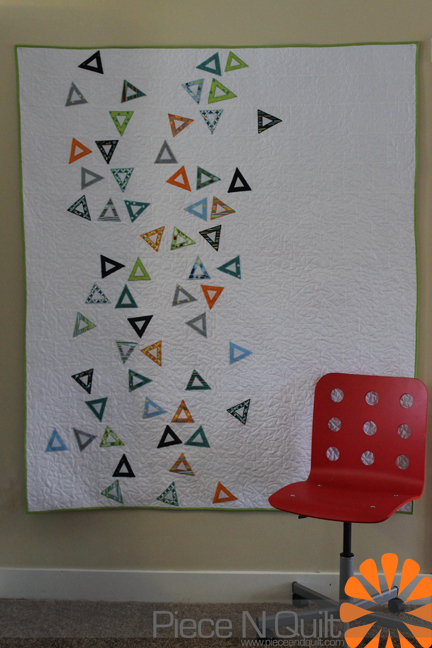
Confetti – A Modern Embroidery Applique Quilt


Hi there! It’s Natalia Bonner from Piece N Quilt and I’m excited to share our Confetti quilt here today! As you’ve probably noticed Kathleen and I have gone Machine Embroidery Applique crazy! We love it! Every single project we see we are trying to figure out how we can add machine embroidery applique.

This new quilt was so much fun to make. It’s made from Zen Chic’s new fabric line Barcelona and a little bit of Moda Bella Solids. We call it the darling Confetti quilt! Finished size is 60″x70″

The instructions below are for using a machine embroidery applique technique but you can achieve similar results by outlining the triangles with a satin stitch on any sewing machine.


4 1/4 yards white background fabric OR 6 white charm packs
1 Fat Eighth Bundle Barcelona by Zen Chic for Moda Fabrics
1/4 yard Green Binding
3.8 yards Backing 


Cutting
From background fabric, cut 27 strips measuring 5″ x WOF and 2 strips measuring 2″ x WOF.
Subcut 5″ x WOF strips into:

  •  208 squares measuring 5″ x 5″
  • 16  rectangles measuring 5″ x 2 5/8″

Subcut 2″ x WOF strips into:

  • 58 – 2″ 60 deg white triangles*

From fat eighths, cut:

  • 58 – 4″ 60 deg print triangles*  (we tried to do two from each print)

To cut triangles, use the templates in the Printer Friendly file or use the 60 degree mark on your ruler to cut the correct shape.

    Applique
    The triangle digital machine embroidery applique file is currently available for free! Click {here} to download from our website. Check out all of our other darling Embroidery Appliques while you’re over there.

     **All applique on this quilt is done using embroidery applique, for this technique you will not cut your triangles into triangles at this point. Follow our triangle Machine Embroidery Applique Tutorial {here}.**

    If you are using a satin stitch instead of machine embroidery applique, pin each print triangle to a 5″ square. Outline with a satin stitch using coordinating thread. Repeat for all 58 triangles.

    Layer a 2″ white triangle on top of each print triangle and outline with a satin stitch. Repeat for all 58 white triangles. You  can use a small pair of very sharp scissors to trim out the print fabric behind the white triangle.

    Assemble the Quilt Top

     Confetti is laid out like subway tiles, alternating blocks.

    Refer to quilt layout for exact placement. We rotated our triangle blocks to get a more random look.

    Quilt, bind, and enjoy! The super cool thing about embroidery applique, because it’s done so precisely with a nice satin stitch when washing this applique there will be no fray! The quilt can be washed and washed and it will look nice forever! This quilt is machine quilted with a pantograph pattern designed by Natalia Bonner called Crackle, available {here} in {digital} and {paper} pantograph pattern.

     All of our embroidery applique is done on a Bernina Aurora 440QE with the embroidery module. Batting used is this quilt is Quilters Dream Poly Select.  


    1- 60″x70″ Confetti Quilt

    Natalia Bonner
    {www.piecenquilt.com}

    Simple Snowman Mini Quilt


    Early Season’s Greetings fellow Bakers! This is Robin over at Craft Sisters. Here’s a simple idea for a winter/holiday wall quilt using jelly roll strips and a fat quarter. It’s so great to be sharing it with you. Joy Batiks from Laundry Basket Quilts delivers the perfect colors for this and I love red (makes it an easy choice for the background for me). The greens are also gorgeous or a combo could be great too. There are lots of things you could do with this design and some other ideas are suggested at the end of the recipe. Hope you have fun with it.


    1 Jelly Roll Joy Batiks from Laundry Basket Quilts 42120JR
    1 Fat Qtr. Joy Holiday Pudding 4212585 for snowman circles
    1 Scrap Lightweight sew in interfacing (big enough for 3 snowman circles)
    2/3 Yd. Backing fabric
    24″ x 30″ Low loft batting (suggest fusible batting)
    White chalk pencil for tracing tree Freezer paper
     18 4-mm press on crystals for snowflakes
    1 Skein Rayon embroidery thread (ivory or cream) for snowflake embroidery
    1 Skein Sashiko thread or embroidery thread for tree stitching


    Make the Appliqué Background 
    Choose 10 strips from jelly roll in high contrast to snowman circle fabric. Cut strips in half and remove selvedges. Sew 10 half-strips together lengthwise using 1/4″ seam allowance. Press seams to one side. Save the other half-strips for another project. Choose two more strips for borders. Sew border strips to sides of background. Press seams out. Trim and square. Sew border strips to top and bottom of background. Press seams out. Trim and square and set background piece aside.

    Make Snowman Circles 

    Using the circle templates found in the Printer Friendly Version, trace 1, small, medium, and large circle on to sew-in interfacing. Leave an inch of space between the traced shapes.

    Place and pin interfacing circle on right side of the snowman fabric. Shorten your stitch length (15-18 stitches per inch) and sew around circles on the drawn line. The needle down feature of your machine really helps here with staying on the line, stopping and pivoting.

    Trim the circles leaving 1/8″ – 1/4″ seam allowance outside the drawn lines. Cut a center slit in the interfacing only of each circle.

    Turn circles right side out and use a chop stick to smooth seams. Press. I love this method of appliqué because it adds a bit of dimension and is a stabilizer for the embroidery.

    Note: It’s easy to remove the interfacing if you don’t want it by following these steps: Use water soluble thread in the needle and regular thread in the bobbin to sew around the circles. Trim and turn circles right side out and smooth seam with chopstick. Lightly spray circle edges with fabric sizing. Press edges with steam and interfacing will lift away. Edges will still be turned under and bobbin thread can be removed or remain to help maintain edges.


    Use a window or a light box to trace snowflake embroidery lines on each circle. Embroider the snowflakes using two strands of rayon embroidery thread (rayon thread adds some shine). Stem or outline-stitch each snowflake. Couch or use fly stitch for the snowflake cross pieces. Crystals get ironed/pressed on after snowman is appliquéd to background.

    Trace the Fir Tree


    Trace numbered tree lines on to freezer paper, leaving generous space between lines. Cut out the separate pieces.


    Place top of tree shape on to background fabric 3″ down from the top edge and 4″ in from left edge (not including borders).  Iron the shape with the waxy side of freezer paper down. Trace around the shape using a white chalk pencil. Peel off the paper shape.

    Press line #2 in place and trace. Continue with remaining pieces until tree is entirely traced.

    Place and Appliqué Snowman Circles
    Pin circles in place and hand or machine stitch using your favorite method.

    Stitch Tree on Background 


    You won’t need to stitch the entire tree because the snowman covers part of it. There are a number of ways to stitch this tree. Choose what you like best and stitch it – whether it is outline embroidery, bobbin work, Sashiko (Japanese surface embroidery), small ric rac. I opted for Sashiko. Here are a few basics to get you started. It’s fun and relaxing and no hoop is needed. Use a Sashiko needle and Sashiko thread. The thread stands out on the surface and is easy to work with. Sashiko needles are longer than regular embroidery needles. Cut the thread approx. 20″ and knot one end. Load needle with several stitches before pulling it through. Pull fabric taught so there isn’t any puckering. Try to make all of your stitches and spaces between the same length (think rice grains). End stitches in corners to define a pattern sharply. Space stitches so they don’t touch or cross where pattern lines connect. Knot on back when you finish.

    Apply Crystals to Snowflakes
    Place press on crystals on to snowman circles as shown on template and in photos. Press each one following manufacturer’s directions. A small craft iron is helpful for this step (easier to control and not bump crystals out of place).

    Finishing 
    Make a quilt sandwich (spray baste or use fusible batting) and quilt around the tree shape close to all Sashiko stitches and around snowman circles. Quilt vertical lines in the ditch in remaining background strips. Trim and bind using left over jelly roll strips. Add hanging strip to back and hang in a noticeable place.

    Or… add one more border and use it to wrap quilt around an art canvas. Staple to secure and add picture wire to hang. The intent for this quilt was to keep it very simplistic but a lot more could be done with it.

    Here are a few more ideas to try using the rest of your jelly roll.

    • Make it a pillow(s) 
    • Make it a much larger quilt using the whole jelly roll for background, enlarging the snowman and quilting a fancy holiday motif inside the circles. 
    • Make it a runner lengthening the background and adding a tree and snowman to each end.
    • Make the tree an appliqué instead of stitching it out.

     
    One simplistic, wintery, snowman, wall quilt approximately 21″ x 25″


    I hope to try some of those other ideas and will post pictures on my blog. Please stop by and visit.

    Thanks,

    Robin Nelson
    {www.craftsisters.com}

    Star Log Cabin and Mini Quilt


    Finished Quilt Size: Approximately 40” x 40”

    Welcome back to the Cabins!

    I had so much fun with the Down on the Farm quilt on the September 26th Bake Shop, that I just had to return with a couple of “minis” for everyone.

    The gorgeous Midwinter Reds fabric line from Minick and Simpson is just perfect for building log cabins, so I am going to continue
    the theme here.

    The table topper size quilt is going to look amazing for my Christmas decorating and the little mini is a show stopper at any time of the year and will be showcased in a prominent spot in my quilting studio.

    Happy quilting!

    – Marlene Biles – Sipiweske Quilts


    Ingredients for Star Cabins:
    1 – “Midwinter Reds” layer cake by Minick and Simpson
    First border: 1/4 yard
    Second border: 1/4 yard
    Third border: 1/2 yard
    1/4 yard background fabric for paper-pieced cabin blocks
    1/3 yard centre squares and binding fabric
    1 1/4 yards of backing fabric (ensure that there is at least 42“ of usable width – if not, you will need to purchase extra and piece it together to get the width required.)
    44” x 44” batting

    Ingredients for Mini Log Cabins:
    Scraps from the layer cake
    Two copies of the pattern sheet
    Scraps of fabric for borders
    Frame with a mat opening of 8” x 8”


    Double matting to match your mini log cabin;
    Barn board frame to finish off your masterpiece.

     
    PLEASE READ ALL INSTRUCTIONS BEFORE STARTING THIS PROJECT.
    The blocks shown above are for your reference during the construction process.  If you are using a planned colour placement for your blocks you could cut your strips and label them as to the placement number as shown in the block above on the right.  If you are making your block scrappy, just be sure to follow the light side for your lights and the dark side for your darks.

    Now it’s time to open up that gorgeous layer cake and make a few decisions.  Do a quick flip through all of those fantastic prints and separate the reds into one stack, the creams into one stack, the tans into another stack and a separate stack for the prints that you don’t think will work in your layout.  To get the star effect you will be making the following:

    4 – all cream blocks (avoid prints that have too much red);
    4 – all red blocks (avoid prints that have too much cream or tan in them);
    8 – 1/2 red and 1/2 cream blocks.
    As a color guide see the reference block above.

    Now have a look at your four paper pieced log cabins and decide which prints you want to use for them.  1 1/4” is the widest strips that you need for the cabin and the roof units; a 2 1/4” piece is needed for the window.  If you are using a print that has not been used in the 16 log cabin blocks then there is no concern as to whether you will have enough.  If you are using some prints from the log cabin blocks, then just make sure that you set aside some for your paper pieced cabins.  Or you can make your four paper pieced log cabins before starting the 16 blocks and eliminate the “surprise” factor.

    How to Cut Log Cabin Strips:
    Make a stack of 4 to 6 prints from the 10″ x 10″ squares that you have selected for your log cabin squares (or whatever number you are comfortable cutting through at one time).

    Line up the left hand edges of your stack as close to perfect as possible.  Measure 1 5/8” from the left raw edge and make your first cut.
    Flip the strip around and trim off the raw edge to make a perfect 1 1/2” strip.

    Continue cutting 1 1/2″ strips.
    From the light strips cut 4 – 1 1/2” strips from each print and from the dark prints, cut 5 – 1 1/2” strips – all your strips will be 10” long – do not cut into shorter segments at this stage. If you prefer, cut one strip less of each of the prints and then just go back later in the construction process and cut a few of the prints that you feel you want to have a bit more of.
    Using the yardage that you have chosen for your centre squares, cut 1 – 1 1/2” x 42” strip and sub-cut into 16 – 1 1/2” x 1 1/2” squares.
    Before you start sewing – check your seam allowance.  A perfect 1/4” is preferred, but in all cases ensure that whatever seam allowance you start with you continue through the entire quilt construction process.  To achieve the 7” finished square blocks for this project, I needed to move my needle setting over to the right by a couple of nudges.  Everyone’s machine may sew just a bit different and everyone’s presser foot might be a bit different, so be prepared to maybe have a 7” x 7” finished block, and maybe not.
    How to Sew Log Cabin Blocks:
    Step One:
    Place a centre square and  a light strip right sides together and join with a 1/4” seam, using the machine’s presser foot as a guide.  Now line up your ruler against the straight edge of Print #1, and using your rotary cutter trim away the excess of Print #2 (refer to the block legend shown earlier for reference).  Open squares and press seam allowance away from the centre square.
    NOTE:  Remember that the last strip you added is always on top under the needle.  Sew with the wrong side of the finished work facing you, the new strip will always be underneath so that you can see the seam allowances and guide them away from the centre of the block as you stitch.

    Step Two:
    Lay this unit on top of another light strip – right sides together.  Stitch this seam as shown in the photo.  Ensure that you push the seam allowance up as you sew over it.  Trim off piece #3 evenly with piece #1.  Press seam allowance away from the centre square.
    Step Three:
    Turn the unit so that piece #3 is at the top and lay this section over a dark strip (#4).  Align the raw edges and stitch, ensuring that the previous seam allowance is pushed upwards.  Trim unit evenly with piece #1 and #2.  Press seam allowance away from the centre square.
    Step Four:
    Now lay this partial block on top of another dark strip (#5).  Stitch and trim strip #5 even with the edge of unit #2 and #3.  Open up and press.

    Continue adding and trimming strips in this manner, always turning the block counter-clockwise as you add strips, until you have a block 7 1/2” x 7 1/2” square that looks like the block above.  Assembly line piecing works very well with this type of block if a planned colour placement is used.  As in the samples shown here, the prints are randomly placed which makes it a bit more difficult to use the assembly line method – a modified version does work, but not quite as efficiently.
    Give all of your blocks a final pressing and get them stacked and ready to lay out into a quilt.  Refer to the photo below or play around with different layouts to find one that appeals to you.
    Cutting Strips for Paper Piecing:
    If you have some leftovers from the Log Cabin Blocks (1 1/2”), these can be used for:  House Roof; House Door; and Chimney, or cut 1 1/2” strips from your chosen prints.
    For the House Window cut a 2” strip from remaining 10” x 10“ fabrics – they can all be the same or different – your choice!
    From your background fabric (42” wide) cut two 1 1/2” strips and one 2 1/2” strip.  The 2 1/2″ strip is needed for the left side of the roof unit and the top of the block.  Add a 1 1/2” background strip to each side of the cabin once it is constructed and a 2 1/2” strip to the top of the cabin block. If you need to adjust the log cabin blocks to fit your border when it is completed, the 2 1/2″ strip across the top is where you can add a bit to or subtract a bit from, so you may want to leave this strip off until you finish your border strip set (see instructions below).  Trim it to match your border right before sewing it to either end. 
    Border Construction:
    The borders for this quilt are done in strip sets.
    1. The first step is to measure the four sides of the quilt top, and mark down the most consistent measurement.
    2. From your first border print cut four (4) 1 1/2” strips of your recorded measurement.
    3. From your second border print cut four (4) 2” strips of your recorded measurement.
    4. From your third border print cut four (4) 4” strips of your recorded measurement.
    5. Sew the first and second border strips together, matching at either end.  Press the seam to the darker print.  Repeat for the other three sides of the quilt.
    6. Sew the third border strip to the second border strip, matching at either end.  Press the seam to the darker print.  Repeat for the other three sides of the quilt.
    7. Sew a border strip set to two opposite sides of the quilt top, matching at either end (pin at intervals along the entire length).  Press seam towards the border.
    8. Sew a paper pieced cabin block to either end of the remaining two border strip sets.
    9. Pin this border unit, right sides together and matching seams at borders, sew the final two borders in place to complete the quilt top.
    Final pressing:  Your quilt top is now done and ready for one final pressing before being layered and basted for quilting.
    Binding:  Measure the top, bottom and sides of your quilt and divide this number by 42” (width of fabric) and using the number you get, round up to the nearest whole number.  This is the number of 2 1/4” strips you need to cut for binding strips.  Using a diagonal seam, stitch these strips into a long continuous unit.  Press strip in half with wrong sides together.  Stitch to the right side of the quilt aligning raw edges as you go and mitering corners as you come to them.  Turn edge over to the back side of the quilt and hand stitch in place.
    Log Cabin Mini:
    This tiny quilt is also made using 16 log cabin blocks.  Make two copies of the attached pattern sheet.  Leftovers from the larger quilt can be used to construct this little mini.  If you need to cut strips as well, you can cut these into 1” widths.
    Following your favourite method of paper piecing, construct the 16 log cabin blocks.  If paper piecing is new to you, do some research on-line for some of the different techniques and give each a try to see which method you prefer.
    Some tips that I can give you:
    1.  Reduce your stitch length to a smaller one than you usually use.

    2.  Trim each seam to less than 1/4” so that it fits into the strip width of the block.

    3.  Be sure to always clip your threads – you don’t want to be dealing with those when working with such a tiny project.

    4.  When cutting your blocks apart on the pattern sheet be sure to leave extra paper around the dashed lines – this makes it easier to hang onto and reminds you to make sure that the fabric is wide enough to go past the seam lines on the pattern.

    5.  Pressing as you go is not necessary.  The project is small enough that a quick finger press is all that is required.  If you do use your iron, remember to PRESS the blocks – do not iron them from side to side.  A final press once the blocks are completed is recommended before trimming.

    Trimming and Constructing:
    This is where the extra paper and fabric that you left beyond the cutting lines now becomes a factor. Each block can now be trimmed by cutting directly on the cutting line (dashed lines) and each block will be the exact same size.  This is important when sewing the tiny blocks together – all you should have to do is line up the paper edges of each of the two blocks being sewn together (right sides together), hold them tight together and sew directly on the seam line.  There really isn’t a lot of room on these little blocks for pins, so I find this is a critical step in the construction of the quilt.
    There are a number of ways that you can lay out your little quilt and it is fun to play around with the blocks to see which design you prefer.  If you have a camera take shots of each of the layouts and then see which one you prefer.
    Sew the blocks together into rows.  You can remove the paper from the sewn seams only if you want to remove a bit of bulk before you sew the rows together.  You can also press the seams open to make things lay a little flatter – there is a bit of bulk in a tiny quilt like this!!!
    I took my mini-quilt to a frame shop and chose mats that worked best with the tones in my quilt. They had me add a wide enough border to all four sides of the quilt so that it could be stretched around a backing board (foam core or some other firm surface) that would fit into the frame I had chosen.  Once again a little research on-line can also yield some wonderful ideas for finishing your mini.  The little quilt should measure approximately 8” x 8” when done, so that would be the measurement of the mat opening – you would then be able to choose to have a 10” x 10” frame or a 12” x 12”, with the gorgeous little masterpiece centred and on display.
    Working in miniature is a challenge but well worth the effort.  Have fun!!!
    Star Log Cabins:  Finished Quilt Size: 40” x 40”
    Mini log Cabins:  Finished Quilt Size: 8” x 8”

    Twists and Turns


    Hello fellow bakers 🙂  I’m Melissa Corry from Happy Quilting and I am super excited to share a new quilt with you today.  Twists and Turns is a super easy quilt that is made from one block but has endless layout possibilities.  So whether you are into a modern square, an improv maze, or a traditional braid, you are sure to find the quilt design that fits you 😉  So, let’s get right to it 🙂

    To make a Twists and Turns 84″x 84″ picnic size quilt you will need:

    2 Bluebird Park Jelly Rolls by Kate and Birdie
    2 1/6 Yards of the Grey Flower print  (13106 18)
    1 1/6 Yards of the Yellow print  (13108 19)
    5 Yards of any print for Backing

    STEP 1 – CUTTING

    We will start with the Yardage.  From the Grey print yardage, cut (30) 2 1/2″ x WOF strips.  From those strips sub-cut (36) 2 1/2″ x 2 1/2″ squares, (36) 2 1/2″ x 12 1/2″ strips, and (36) 2 1/2″ x 14 1/2″ strips.  Set aside.  From the Yellow print yardage, cut (15) 2 1/2″  x WOF strips.  From those strips sub-cut *36) 2 1/2″ x 6 1/2″ strips and (36) 2 1/2″ x 8 1/2″ strips.  Set Aside.

    Now it’s time to move onto the jelly rolls.  From the 2 Jelly Rolls select 54 strips.  I used the light grey, green, blue, and coral strips setting aside the yellow and dark grey strips for binding.

    Divide the 54 strips into 2 piles, one pile of 18 strips and one pile of 36 strips.  Evenly distribute the colors in each pile.

    From the pile of 18 strips, cut each strip while folded into a 10 1/2″ and (2) 4 1/2″ increments.  This will create (4) 2 1/2″ x 4 1/2″ rectangles and (2) 2 1/2″ x 10 1/2″ strips from each strip.  Cut all 18 strips this way and group the pieces into piles of similar size.

    From the pile of 36 strips, open the strip and cut one of each of the following pieces from the strip.  A 2 1/2″ x 12 1/2″ piece, a 2 1/2″ x 10 1/2″ piece, a 2 1/2″ x  8 1/2″ piece, a 2 1/2″ x  6 1/2″ piece, and a 2 1/2″ x 2 1/2″ square.  Cut each of these pieces from all 36 strips.  Group these with the other prints into piles of similar size.

    From your Jelly Rolls you should now have the following pieces

    STEP 2 – BUILDING BLOCK

    To start the block, gather a grey yardage 2 1/2″ square and a colored print 2 1/2″ square.  Place with right sides together and stitch a 1/4″ seam along the edge, aligning as you sew.

    Chain stitch 36 similar sets.  Chain stitching is just sewing one set after another without clipping threads in between.  Once you are through sewing all 36 sets, clip the threads and press toward the colored print.

    Now, layout your pieced set and a colored print 2 1/2″ x 4 1/2″ rectangle as shown.  Place the rectangle onto the pieced set with right sides together and aligning the raw edge.  Stitch a 1/4″ seam along the edge.

    Repeat for all 36 pieced sets chain stitching as you go.  Once you have chain stitched all 36 sets, clip the threads and press towards the 4 1/2″ print piece.

    And now the process will repeat again and again 🙂

    Grab a colored print 2 1/2″ x 4 1/2″ rectangle and place it onto the side of the pieced unit with right sides together and aligning raw edges as shown.  Stitch a 1/4″ seam along the edge.  Repeat for all 36 sets chain stitching as you go.  Clip the threads and press towards the newly added piece.  

     Now, grab a colored print 2 1/2″ x 6 1/2″ rectangle and place it onto the top of the pieced unit with right sides together and aligning raw edges as shown.  Stitch a 1/4″ seam along the edge.  Repeat for all 36 sets chain stitching as you go.  Clip the threads and press towards the newly added piece.

    Grab a yellow yardage 2 1/2″ x 6 1/2″ rectangle and place it onto the side of the pieced unit with right sides together and aligning raw edges as shown.  Stitch a 1/4″ seam along the edge.  Repeat for all 36 sets chain stitching as you go.  Clip the threads and press towards the newly added piece.  

     Now, grab a yellow yardage 2 1/2″ x 8 1/2″ rectangle and place it onto the top of the pieced unit with right sides together and aligning raw edges as shown.  Stitch a 1/4″ seam along the edge.  Repeat for all 36 sets chain stitching as you go.  Clip the threads and press towards the newly added piece.

    Grab a colored print 2 1/2″ x 8 1/2″ strip and place it onto the side of the pieced unit with right sides together and aligning raw edges as shown.  Stitch a 1/4″ seam along the edge.  Repeat for all 36 sets chain stitching as you go.  Clip the threads and press towards the newly added piece.  

     Now, grab a colored print 2 1/2″ x 10 1/2″ strip and place it onto the top of the pieced unit with right sides together and aligning raw edges as shown.  Stitch a 1/4″ seam along the edge.  Repeat for all 36 sets chain stitching as you go.  Clip the threads and press towards the newly added piece.

    Grab a colored print 2 1/2″ x 10 1/2″ strip and place it onto the side of the pieced unit with right sides together and aligning raw edges as shown.  Stitch a 1/4″ seam along the edge.  Repeat for all 36 sets chain stitching as you go.  Clip the threads and press towards the newly added piece.  

     Now, grab a colored print 2 1/2″ x 12 1/2″ strip and place it onto the top of the pieced unit with right sides together and aligning raw edges as shown.  Stitch a 1/4″ seam along the edge.  Repeat for all 36 sets chain stitching as you go.  Clip the threads and press towards the newly added piece.

    Almost done!!!

    Grab a grey yardage 2 1/2″ x 12 1/2″ strip and place it onto the side of the pieced unit with right sides together and aligning raw edges as shown.  Stitch a 1/4″ seam along the edge.  Repeat for all 36 sets chain stitching as you go.  Clip the threads and press towards the newly added piece.  

     Now, grab a grey yardage 2 1/2″ x 14 1/2″ strip and place it onto the top of the pieced unit with right sides together and aligning raw edges as shown.  Stitch a 1/4″ seam along the edge.  Repeat for all 36 sets chain stitching as you go.  Clip the threads and press towards the newly added piece.

    You should now have (36) 14 1/2″ x 14 1/2″ blocks that look something like this 🙂

    STEP 3 – ASSEMBLING QUILT TOP


    And now is the really fun part.  This is where you get to decide what kind of a quilt layout you want.  There are so many possibilities.  These are a few of my favorite 🙂    Play with the blocks until you have the layout you love, and there are lots more options than shown 😉  Once you have a layout you like, sew the blocks into rows and the rows into the quilt top 🙂


    If you decide to do the staircase layout, the same as I did, it is easiest to first sew the blocks into the two  sets of two shown below, making 9 of each set.

    And then sew the sets into two sets of row, making 3 of each row as shown.

    And lastly, sewing the rows into the quilt top.

    STEP 4 – FINISHING

    Now just Baste it, Quilt it, and Bind It.  I know, I make it sound so easy.  If you are new to finishing your quilt, I have created a video tutorial series that goes over the basics of each of these three steps.  You can find it at my blog 🙂   You will use 8 strips you set aside at the beginning to do the binding.

    One adorable 84″ x 84″ Twists and Turns Quilt that is just the design for you 🙂  Thank you so much for joining me and I hope you enjoyed the tutorial.  If you make your own Twists and Turns Quilt I would love to see it.  You can add it to my Inspired by Happy Quilting Flickr group here 🙂

    Have a Happy Quilting Day!!!

    Melissa Corry
    {www.happyquiltingmelissa.blogspot.com}

    Q&A with Oda May: Basting

     {fabric in background is from Scrumptious by Bonnie and Camille}

    Love to piece and quilt but hate to baste? You’re not alone. Join Oda May today as she answers a reader question about basting in small spaces.

    Dear Oda May,

    Greetings from Spain! I started quilting about four years ago and am still a bit green. Is there an easy way to put together all three layers – and get them all wrinkle free – before I start my hand quilting? I don’t have much space and usually put the layers together on the floor on my living room, which is a real pain in more ways than one.

    Crawling on Pins and Needles,
    Consuelo 
     
    Dear Consuelo!

    I feel your pain (literally). Basting is my least favorite part of the process so I have some tips for you to make it less painful.

    Clamps. Instead of suffering on your hands and knees on the floor, why not baste your quilt in small sections on a table top or counter? You can use strong clamps (found in any hardware store) to hold the three layers nice and tight. Use basting pins or a needle and thread with this method.

    Fusible Batting. This may not be an option for hand-quilted projects but fusible batting also allows you to baste in small sections. All you need is space to iron.

    Long-arm Basting. Most long-arm quilters offer basting services for both hand quilters and those who like to do their own quilting at home. Check with some long-arm quilters in your area for pricing and availability.

    Baste in Peace,

    Family Tree Quilted Pillow


    Greetings, Moda Bake Shop readers.  My name is Karen Miller, and I’m a new Chef here at the Bake Shop!  I live in the beautiful Finger Lakes Region of Upstate New York, USA, and I blog about all things Quilty at Karen’s Quilts, Crows and Cardinals.  Stop by and check out my projects, tutorials, and other happenings.

    Today I’m excited to share a Quilted Envelope Pillow recipe using Deb Strain’s “Family Tree” fabric.

    With its beautiful colorways, “Family Tree” is perfect for fall – AND – spring projects!  As you can see from my Blog, I’m addicted to birds – so the Family Tree birds and paisley along with some awesome dimensional cuts have me sold on this line…  I’m sure you will LOVE IT too!

    Several techniques were used to complete the quilted pillow including machine piecing, applique, fussy cutting, and free motion quilting.  Both cotton and wool fabric were used in this sample — I hope you enjoy the variety.

    The finished pillow fits a 20″ x 20″ pillow insert and has a cute little 2″ flange around the outside!

    Pillow Top, Envelope Back and Misc Applique Pieces:

      • 1 Jelly Roll Family Tree #19640JR

    Applique Background:

      • 1 Fat Quarter Family Tree Cream #19649 11

    Applique Tree:

      • 1 7″ x 10″ piece Moda Marble Chocolate #6851

    Other:

      • 28″ square inexpensive cotton fabric for quilted pillow backing
      • 28″ square piece of batting (I used Hobbs Poly)
      • 20″ square Pillow Form

    Optional choices:

    • For Applique Tree:  7″ x 10″ piece Moda Wool Dark Brown #810-58
    • For Applique Birds:  5″ x 5″ scrap of Moda Wool Red #1700-72
    • Quilter’s Freezer Paper
    • DMC #8 Pearl Cotton Thread in Red & Brown for wool applique
    • Aurifil Mako 50/2 in Color #2000 1GN for quilting
    • Aurifil Mako 50/2 in Color #2845 1GN & #2600 ICN for top stitching


    Please review all instructions before getting started. 

    Unless otherwise indicated, all piecing was completed using a scant 1/4 inch seam allowance.


    Pillow Top Piecing:

    Applique Background: Cut one 13″ x 13″ square using Family Tree Cream or any other neutral Moda fabric.

    Pieced Pillow Top : From your Jelly Roll choose 5 to 10 different strips for the pillow top – The sample was completed using 7 different fabric strips and alternating lighter/darker fabrics in the block.


    Cutting and Piecing Pillow Top:  Using the “Piecing and Cutting” diagram below, cut strip sizes and sew to the cream applique background.  Note:  The diagram indicates the order in which you piece AND the size of the cut piece.

    Example:   #1 – 13″ represents the first piece you sew to the background and it is cut 13 inches long.

    Piecing and Cutting Diagram – # indicates the order and ” indicate size to cut

    Note:  Above pieces #9, #10, #11 and #12 were sewn to the pillow top after I completed the applique.  You can sew them on at any time.

    Cutting Tip:   When you’re cutting pieces that are longer than 10 or 12 inches consider this approach:

    Take 1/2 of the desired size as your target, fold your fabric to the target size plus a bit of overlap. Find the target size mark on your ruler and place it on the fabric fold. Trim the opposite end.

    This method allows you to remove the selvage while cutting the desired strip size and helps avoid LONG strip and ruler alignment.

    Now, back to the pillow top — be sure to press your seams toward the outside of the pillow after each strip is sewn.  I was taught to first press the seam flat before pressing it in the desired direction.  The seams come out beautifully using this method.

    Now that you’ve completed most or all of the piecing on the pillow top it’s time to applique!


    Pillow Top Applique: 

    The applique portion of the pillow allows for great flexibility!


    In the completed sample I used Moda Wool for the tree and birds and attached them to the background with a whipstitch (sometimes referred to as an overhand stitch).  The birds were stuffed to give them dimension.   Needle turn applique method was used for the tree leaves.  In all cases, basting was done with applique pins.

    If you would rather not use the sample methods, there are many applique options available including raw or turned edge applique, fused or glued, with hand or machine stitching.  If you have any questions on any particular method, leave a comment here or on my blog, and I would be happy to give you feedback.  Also, check out the great Moda Bake Shop Basics tutorials on Machine Applique and Turned Edge Machine Applique.

    Tree above in Moda Marble — Yummy !

    Tree & Birds:

    If you are using wool and not fusing it down, then you’ll want to have Quilter’s Freezer Paper on hand.  If you don’t have Quilters Freezer paper sheets, you can use rolled freezer paper from your kitchen drawer 😉

    Using the tree template below, trace the tree design to the dull or paper side of the freezer paper.

    Tree Template

    With a dry iron set on **medium heat, press your freezer paper to the right side of the wool.
    **Use care not to burn and/or discolor your wool.

    Cut along the drawn line.  Remove the freezer paper.

    Use applique pins to secure the tree to the background fabric, then use Pearl Cotton thread to stitch using a Whipstitch.


    Finished Tree:

    Once your tree is stitched down, use the same techniques to cut and stitch your birds.

    Bird layout:

    Before stitching the birds to the background you can (optionally) add some dimension by stuffing them with batting.


    Once the birds are stitched to the background, give them each a wing.  I fussy cut paisley wings using clear template plastic to help find the perfect fussy cut.  You’ll notice that I auditioned several different fabrics for wings — there are many great choices.  Choose what looks good to your eye and attach using your favorite applique method.

    After stitching the tree, birds, and bird wings to the background, choose several strips from the jelly roll and fussy cut leaves to complete the tree.  The sample leaves were completed using needle turn applique, but use your favorite applique method.  For a fast and easy solution consider raw edge applique using fusible web to secure and machine top stitch for added interest.

    Once the applique is completed, add the 4 outside border pieces (pieces #9 through #12 from the Piecing and Cutting Diagram above).

    Your unquilted pillow top should measure appx 24 3/4 inches square.


    Prepare for Pillow Top Quilting:

    In the sample, only the pillow top was quilted. 

    Prepare the quilt sandwich on a table top — the pillow size is perfect because nothing drapes over the edges of the table!

    First, lay out your backing fabric — remember this fabric will not show once your envelope pillow is completed, so use a less expensive muslin or a light colored cotton fabric.

    Now secure the backing fabric to the table with tape, pulling it taut, but using care not to stretch your fibers – you don’t want it to spring back when the tape is removed.

    Next, position and smooth batting over the backing, secure it with tape, remembering not to pull too tight.


    Lastly, position and smooth the pillow top right side up on the batting, always smoothing from the center out and securing as you smooth.

    Pin basting is complete.

    I use quilting safety pins to baste my quilt tops, but there are other methods including spray basting and basting with straight pins and soft tips.


    Quilt the Pillow Top:

    Using matching thread and a walking foot, stitch in the ditches along the strip pieces to stabilize the pillow top before Free Motion Quilting the applique area.

    Start at the edge of the applique background and work your way outward – stitching in the ditch.

    Also, baste stitch around the outside perimeter of the pillow top.

    Free Motion Quilt the applique area:

    Free motion quilting is fun and it allows you to enjoy your piece without the wait of someone else doing your quilting for you.   This pillow top is a perfect place to practice free motion quilting..  Here are some basics:

    Use a top and bobbin thread that match the applique background, put your darning foot on, and drop the feed dogs on your machine.  For ease of movement, use a Supreme Slider on your machine bed.  Check out my blog in the next few weeks for more “Free Motion Quilting Basics”.

    Start by echo stitching around each applique piece.   I used Aurifil Mako 50/2 in Color #2000 thread to quilt the applique area – the color matched perfectly!


    After you’ve echo stitched the applique, quilt any design you like to fill in the background.  The more densely you quilt, the more your applique pieces will POP!

    The sample was quilted using a combination of “McTavishing”, circles, and swirls, which all added movement to the piece. 

    Quilt the Pillow Top Strips:

    Once you have finished quilting the applique area, quilt the pieced strips with a top stitch.  I used a 2.70 stitch length on my machine.  Use a thread color that complements the fabric.

    Square Up the Pillow Top:

    Depending on the density of your quilting you may have to make some fine adjustments to square up the pillow top.   On the sample piece the right side was simple and squared up nicely.

    However, because of the dense quilting in the lower left corner of the sample, some “fine adjustments” aka “fudging it” were made on the left and bottom edges.  You can see from the diagram below that the “fine adjustment” included trimming outside of the top fabric, resulting in only the batting and backing being square.

    “Squaring up” which does not cut into the top fabric is not a problem; however, it may require you to increase the seam allowance when the pillow layers are stitched together.   This was the case with the sample pillow.

    The sample piece pillow top squared up at 24.25″.

    Important:  The above measurement is necessary to trim the envelope pieces.  The width of the envelope pieces will need to match the width of the pillow top (trimmed and squared).

    For now, set your pillow top aside and prepare to piece the envelope back.


    Pieced Envelope Back:

    The envelope back requires two pieces:

    • One 19″ by 25″ envelope top (horizontal strips)
    • One 17″ by 25″ envelope bottom (vertical strips)

    The sample was pieced using 13 of the remaining jelly roll strips.

    To piece the scrappy back choose 13 WOF strips from the jelly roll.

    Envelope fabric strips

    Arrange the strips in a layout that is pleasing to your eye.

    Sew the long sides of the 13 strips together.

    When complete you should have a 42″ by 26.5″ rectangle.

    From the rectangle, cut one 26″ by 26″ square, rotate it and trim it to 19″ by 24.25″ (same as the width of pillow top once squared up) with the strips running horizontally.  This is the envelope top.

    Use the remaining 17″ by 26″ piece for the bottom of the envelope.  Trim to 17″ by 24.25″ (same as the width of pillow top once squared up).  These strips run vertically.

    Fold and topstitch one wide edge of the envelope top and one wide edge of the envelope bottom.


    Now you’re ready to layer, pin and sew your pillow layers together!

    Complete the Pillow:

    Be sure all three pieces (Pillow Top, Envelope Top and Envelope Bottom) are the same width.  The sample measured 24.25″ wide.

    Begin by positioning the pillow top, right side up on a table.

    Add the envelope top, right side down on the pillow top.  Align the raw edges at the top, left, and right. Pin.  The envelope top will not cover the entire pillow – align it at the top edge.

    Lastly, add the envelope bottom, right side down over the bottom portion of the pillow top.  Align raw edges at the bottom, left, and right. Pin.  The envelope bottom will not cover the entire pillow top but it will overlap the envelope top by about 6″.

    Using your walking foot sew around the entire outside of the pillow layers using a 1/2 inch seam allowance. The envelope opening will allow you to turn right side out.

    Trim all 4 corners to reduce bulk.  Gently press the seams open.

    Next, turn the pillow right side out through the envelope.  Once right side out, reach inside to push out the corners.  If necessary, from the right side, use a pin to pull the corner fabric out.

    Almost done !

    Press around the outside edges of the completed pillow.

    Sew the Flange

    The flange is made by stitching in the ditch, through all layers, as designated by “A” in the diagram below.  This makes the pillow the correct size to fit a 20″ x 20″ pillow form.

    To give the pillow a more finished look, topstitch around the inner and outer edges of the outside strips as designated with “B” below.

    Below is a close up of the top stitching around the flange:

    Whew – that was fun!

    Now you have a beautiful quilted pillow with flange that you can use for fall or spring decorating.

    Are you ready to get started ?

    Check out the awesome price on the Family Tree Jelly roll at Cindy’s Sew It Is!

    Completed Front and Back:

    One 22″ x 22″ Quilted Envelope Pillow with a 2″ Flange — and plenty of Jelly Roll strips leftover for an accent pillow!!

    If you have questions, leave them in the comments below — I’ll be happy to answer them.

    Also, I would love to have you jump on over to my blog and say hello.

    There are some neat posts about Wool Applique here and here, and if you’re interested in learning more about Needle Turn Applique or Free Motion Quilting, stop by in November when I’ll post some basic tutorials on these topics. 

    I look forward to seeing you there!

    Karen Miller
    {www.karensquiltscrowscardinals.blogspot.com}

    BOO! Table Runner

    Em here from Em’s Scrapbag cookin’ up a little Halloween treat with the Boo Crew. A quick and easy table runner sure to scare up a little fun in your lair.

     
    1 Boo Crew layer cake
    ¾ yard backing
    Fat quarter for binding

    Choose 24 of your layer cake squares. Arrange in sets of two.  (4 set for the Bs and 8 sets for the Os)
    Choose one other 10″ square for spiders in Bs. Make a template from lightweight cardboard of a 6¼” circle.

    For each O
    Choose one of your 10″ squares and place the cardboard template on top and cut a generous ½” seam allowance around it. From the other 10″ cut a 8½” square.

    For each B
    Choose one of your 10″ squares and cut:
    2 – 3½” squares
    1 – 1½” x 6½” rectangles
    From the other 10″ square cut
    6 – 1½” squares
    4 – 1½” x 6½” rectangles

    To make the Os run a gathering stitch ⅛” around the edge of each circle.
    Next pull the gathering stitch until the circle begins to pop up.

    Place the template inside the popped circle and pull the gathering stitches until it encases the template.

    Using Best Press and/or steam press your circle to set edge around template.

    Pop out your template and center on your 8½” square background.  Top stitch in place.

    For your Bs
    Using your 10″ spider square cut 8- 1½” circles.  A spool of thread works good for this.
    With a needle and thread start on the wrong side of the fabric and begin a gather stitch.

    Folding the fabric over as you go.
    Pull tight to create your spider and tie off.  Repeat with remaining circles

    Sew a 1½” x 6½” B rectangle to a 1½” x 6½” background rectangle.

    Take the 3½” square and sew the 1½” squares on the diagonal on three of the corners. Trim seam allowance.

     Sew a yo yo spider in the center of this block.  Repeat with the other 3½” square, remaining 1½” squares and yo yo spider.

    Sew these two blocks together.

    Sew the two 1½” x 6½” rectangle unit to the side of this.

     Sew another 1½” x 6½” rectangle to the other side of your B.

    Sew the remaining 1½” x 6½” rectangles to the top and bottom of your B.
    Sew a B to two Os to create your Boo units.  Make 4.

    From your scraps or remaining 10″ squares cut 4- 5″ x 6 1/2″ rectangles and 1- 4 1/2″ x 6 1/2″ rectangle. Sew these together with the smaller rectangle in the center. Sew this piece between two of the Boo units.

    You can stop here to make a table mat or add the remaining Boo units on either end for a runner.

     Sandwich top with batting and backing and quilt as desired.  I quilted spiderwebs in mine.

    22″ x 38″ runner

    Emily Bailey
    {www.emsscrapbag.blogspot.com}

    Scrumptious Scrappy Chevron Picnic Quilt


    Hi Everyone!  I’m Rhonda from Patchwork Sampler and I’m thrilled to be sharing my first Moda Bake Shop project with you.  This is an easy project that’s perfect for a baby quilt, throw or bed topper.  I used the beautiful “Scrumptious” line of fabric from Bonnie and Camille for this quilt and it turned out to be a wonderfully bright, happy project!

    Fabric:
    One layer cake-Scrumptious by Bonnie and Camille
    1 yard of background-Bella Porcelain (9900-182), Scrumptious Cream Solid (55078-17) or similar fabric
    2/3 yard binding-Scrumptious Diagonal Stripe Aqua (55071-12)
    3½ yards backing-I used Scrumptious Aqua (55073-12)

    Tools:
    Pencil
    Rotary cutter and ruler
    Basic sewing supplies
    Sewing machine


    Use ¼” seams throughout this project unless otherwise noted.  Pressing directions are given when it makes a difference in piecing units or sewing blocks together. There are two squares of the cream solid in the Scrumptious layer cake.  I did not use those in my project because of the similarity to the background fabric.  Just set them aside and use them in another quilt!

    This quilt is made from two easy blocks.  We’ll start by making Block A, the chevron block first.

    Cut each of the remaining 40 squares in half so you have (2) 5″ x 10″ rectangles from each. Make two stacks of rectangles.  One set will be used in block A.  Set the other set aside to use for Block B.

    Cut each of the rectangles from the Block A set in half, making two 5″ squares from each.

    Select 42 of the 5″ squares to use for the half-square triangles (HST) in Block A.  Be sure to select squares that contrast with your background. Trim each of the selected squares to 4⅞” square.  Set the remaining 5″ squares aside to use in Block B.

    From the background fabric cut (6) 4⅞” strips.  Sub-cut into (42) 4⅞” squares. Draw a diagonal line on the back of each background square.  Pair each of the background squares right sides together with a print square.

    Sew a ¼” seam on both sides of the drawn line.  Then cut apart on the drawn line.

    Press seams toward the print fabric and clip off the “dog ears.”  Your HST units should measure 4½” square.  Make 84 HST blocks.

    Select four HST units for each block.  Try to choose four different colors and prints for each block.
    Layout a set of four HST units as shown below.  Make sure the triangles are placed correctly to form the chevron.

    Sew the units together into pairs.  To reduce bulk, press the seams open.

    Sew the pairs together to make the block.  Again, press seams open.  Make 21 blocks.  Your blocks should measure 8½” square at this point.

    Now gather up the 5″ x 10″ rectangles you set aside along with the remaining 5″ squares and get ready to do some more cutting to make the “B” Blocks.

    Cut each of the 5″ x 10″ rectangles in half lengthwise to make two 2½” x 10″ rectangles.

    Select 56 of these rectangles and sub-cut them to 2½” x 8½“.
    From the remaining 2½” x 10″ rectangles and 5″ squares, cut (112) 2½” x 4½” rectangles.

    Sew pairs of 2½” x 4½” rectangles together along the short side.  Press seams to one side.  Make 56 pairs.

    For each B Block select two 2½” x 8½” rectangles and two units from the previous step.  Try to get an assortment of colors and prints for each block.

    Sew the blocks together as shown.  Press all the seams up toward the 2½” x 8½” rectangle at the top. Make 28 blocks.  Blocks should measure 8½” square at this point.

    Now you should have 21 “A” Blocks and 28 “B” Blocks and you’re ready to lay out the quilt.  It has seven rows of seven blocks each.  The odd numbered rows are “B” blocks and the even numbered rows are “A” blocks.

    Every other block in Rows 1, 3, 5 and 7 are rotated 180 degrees (just turn them upside down!).
    Lay out four rows that look like this and sew them together.

    Now lay out three rows that look like this and sew them together.  All blocks go the same way on the even rows.

    Sew your rows together to finish your quilt top.  Press the seams toward the odd rows.

    Cut your backing into two 1¾ yard pieces.  Cut off the selvages and sew the pieces together for the backing.  Layer quilt top with batting and backing, then quilt as desired.  This is how I quilted mine.

    In the odd rows I simply quilted continuous up-and-down lines.

    In the even rows, I got a little fancier (but still very easy) and quilted little pebbles in the background.  The chevrons were quilted with three wavy lines. I quilted in the ditch to outline the chevrons and on the seams between rows.

    Bind your quilt and enjoy!  If you need help binding, there is a MBS tutorial here.


    One quilt, approximately 56″ square.
    A limited number of Scrappy Chevron Picnic Quilt kits are available in my Etsy shop here. Sorry, kits are now sold out.

    Rhonda Roberts
    {www.patchworksampler.com}

    Layer Player Quilt


    Welcome to another great tutorial from Quilted Works! One of our fantastic quilt designers, Julie Macfarlane, designed this quick and easy Layer Cake Quilt. She used the new fabric line by American Jane called “Pot Luck.”

    • 1 Layer Cake
    • 1/2 yard fabric for binding
    • 53″ x 60″ piece of batting
    • 2 1/2 yards fabric for quilt back


    Select a Layer Cake. Divide the Layer Cake into 21 pairs, making sure that the fabrics coordinate well and create a contrast with each other.

    Place two contrasting layer cake pieces right sides together and stitch 1/4″ seam along the two parallel sides. Then, also stitch a seam at 1 1/2″ (from the edge of the fabric) on these same sides.

    Now we are going to cut two strips off of each side. First, cut 1 1/4″ from the edge, then move your ruler to cut a second 1 1/4″ strip. It helps to place the stitch line directly on the 1″ mark of your ruler. Do this to both sides, and you will end up with 4 strips.

    Using the remaining center piece 5″x10″, stitch again at 1/4″ and 1 1/2″ on the short (5″) sides of the fabric. Trim them the same way as above. You will end up with 4 pieces.

    To reassemble the blocks, first sew the short sides onto the center 5″ square, then press.

    Next, trim the long strips to 8″ and sew onto the top/bottom of the blocks. Press your finished block.

    The finished block size will be 8″ square. You will then begin laying the blocks out with 6 blocks across and 7 rows down. Every other block is rotated 90 degrees. Arrange the blocks to your liking and sew the rows together.

    45″ x 52″ Quilt 

    We hope you all have a great time making this quilt! For information on kits, please visit our website at www.quiltedworks.com
    Barb Johnson with Julie Macfarlane for Quilted Works

    Contempo Throw Quilt


    At The Calico House, we love to create new projects to showcase the fabulous fabrics in our shop. We’re excited to be accepted as a Moda Bake Shop Chef and share our “Contempo Throw” with you!

    This 55¾” x 70½” contemporary quilt features Moda’s “Contempo” line of fabric. A piano key border of 9 coordinating fabrics complements the beautiful center panel and inner borders. The glowing oranges, mustard golds, and relaxing taupe colors make this a perfect autumn throw!


    • 1 ⅔ yards of Contempo Spice 32841 14 Moda 
       (For the design to be centered may require more fabric)
    • 7/8 yard of Bella Solids Weathered Teak 9900 129 Moda
    • ½  yard of Contempo Mustard 32846 18 Moda
    • 1 Contempo layer cake OR 1/8 yard cuts of 9 coordinating fabrics

     
    Use ¼” seam allowances throughout, unless otherwise noted.
    Note: All measurements are based on unwashed fabric.

    • Contempo Spice 32841 14 fabric is the center of the quilt. Cut center 43 ½” x 58″
      (pay attention to the pattern repeat).
      Cut the selvage off each side so the pattern is equal on both sides.

    • ¼” accent border is Bella Solids Weathered Teak 9900 129.
      Cut (5) ¾” x WOF (width of fabric) strips.

    • 2″ inner border is Contempo Mustard 32846 18. Cut (5) 2 ½” x WOF strips.
      Cut (1) 3 ½” x WOF strip. From this strip cut (4) 3 ½” squares for cornerstones,
      then cut 2 ½” x the amount needed to complete the inner border. Join strips for side borders:
      (2) 2 ½” x 59″ strips. Join strips for top and bottom borders: (2) 2 ½” x 48″ strips. Trim to fit.

    • ½” accent border is Bella Solids Weathered Teak 9900 129.
      Cut (5) 1″ strips x WOF. 

    • The piano keys outer border is created by making strata from (9) coordinating fabrics.
      Cut 3″ x  WOF from each fabric. Join, then cut into 4″ strips. If using a layer cake, cut coordinating 
      colors into 3″ strips. You’ll need 45 strips to make your strata, then cut into 4″ strips.
      
    • Cornerstones: Use the (4) 3 ½” squares previously cut from the Contempo Mustard fabric. Add 1″
      Bella Solids Weathered Teak 9900 129 strips to 2 sides (the binding adds the other 2 sides).

     • Quilt as desired.

    • Cut Bella Solids Weathered Teak 9900 129 for binding in 3″ strips for a finish border/binding. Sew 
      on with a ½” seam allowance.

    Note: Meaurements on the diagram are finished block and strip sizes
    (¼” seam allowances are not included on the diagram).


    55 ¾” x 70 ½” Throw

    We hope you enjoy sewing this great “Contempo” throw.

    We have Contempo Throw Kits available at our store or on Etsy. (Quantities Limited)

    The Calico House
    {www.thecalicohouse.blogspot.com}